

I have first cousins scattered around the world, from Venezuela to Jerusalem – more than sixty of them, thank God. I hear about their lives in an extended family WhatsApp chat dominated by the aunts and uncles who actually grew up together.

I feel kinship toward my cousins, but I don’t really know most of them. Distance does that. Pretending otherwise would be sentimental.
This past month, three moments made me think about a similar distance – the distance between American and Israeli Jews.
The first came when I read that members of Israel’s ruling coalition were working to outlaw egalitarian prayer at the Kotel section originally designated for this. It made me deeply sad.
As someone whose work is focused on helping Jews feel the bonds of peoplehood across space and politics, this felt like a signal that non-Orthodox American Jews – who have spent the last year defending Israel in hostile spaces across America – were at best an afterthought in Israeli politics.
The second came in a conversation with an Israeli leader visiting New York, who told me how painful she found the phrase “October 8th Jew.” To her, it sounded as if the renewal of Jewish identity after October 7th in America meant we were less focused on the horror that unfolded in Israel and more driven by our own religious renaissance.
I tried to explain that it didn’t – that we were shattered too, that to be an October 8th Jew meant to stand up for Israel. But I soon realized we were describing the same earthquake from different vantage points, and we couldn’t quite hear each other.
The third is the war with Iran, which, as I write this, is still ongoing. I lost count of how many times my siblings ran to the shelter while I was writing/editing this.

I’m still reading the news obsessively. But I’ve noticed something in myself, and in the American Jews around me – good Israel-loving people. We are checking in less on our Israeli friends and family than we did in the aftermath of October 7th – less than during the Iran war last June.
I’m not the only one to have noticed it. This morning EJP’s Judah Ari Gross covered this as well, writing about how “funders and nonprofit leaders in Israel are describing a marked drop in engagement from their Diaspora counterparts during this round of fighting against Iran and its proxies, compared to similar conflicts over the past two-plus years.”
I’ve been trying to understand why. Is it compassion fatigue? The problems in our own backyard pulling at our attention? Is it the distrust that some American Jews have in this current US administration? Is it a belief that Israelis are resilient and strong?
Or have we developed a certain quiet acceptance that missiles are falling on our friends and family who are huddled in shelters that protect them, that the emergency six thousand miles away has become the weather?
Here’s what I am realizing. This distance isn’t weird. It’s normal. It’s human.
Any relationship stretched across six thousand miles – across languages, governments, and daily realities that barely overlap – will accumulate distance. It would be strange if it didn’t.
The question is not how to pretend the distance isn’t there. The question is how to build something strong enough to hold us together across it.
This is where I find myself returning to the Mishkan.
Jewish tradition understands this problem well. This week’s double portion, Vayakhel-Pekudei, describes the construction of the Mishkan – the tabernacle, the portable sanctuary the Israelites built in the wilderness.
The Mishkan is usually understood as a place of worship. But in context, it’s revealed as something far more. It was built after the sin of the Golden Calf – a catastrophic breach that might have ended the relationship between God and the Jewish people entirely.
God was furious and offered Moses an exit: let me destroy this stubborn people and start over with you. Moses refused. And in the aftermath of that refusal, in the space that forgiveness opened, the Israelites built the Mishkan.
Rashi, the famed medieval commentator, argues the timing is no accident. The command came after the betrayal – as a response to the Golden Calf.
But I think the Mishkan was responding to something even more fundamental than the sin itself. The people weren’t simply weak or faithless. They were struggling with something genuinely hard: worshipping an invisible God. There was no image, no tangible presence, nothing physical to direct their longing.
When Moses disappeared up the mountain, they had nothing to hold onto. According to this interpretation, the Golden Calf wasn’t just a sin. It was a symptom of distance – people desperately reaching for something they could see and touch.
God’s answer was not to demand they simply try harder. It was to ask what this relationship actually needed – and then task the people with building that.
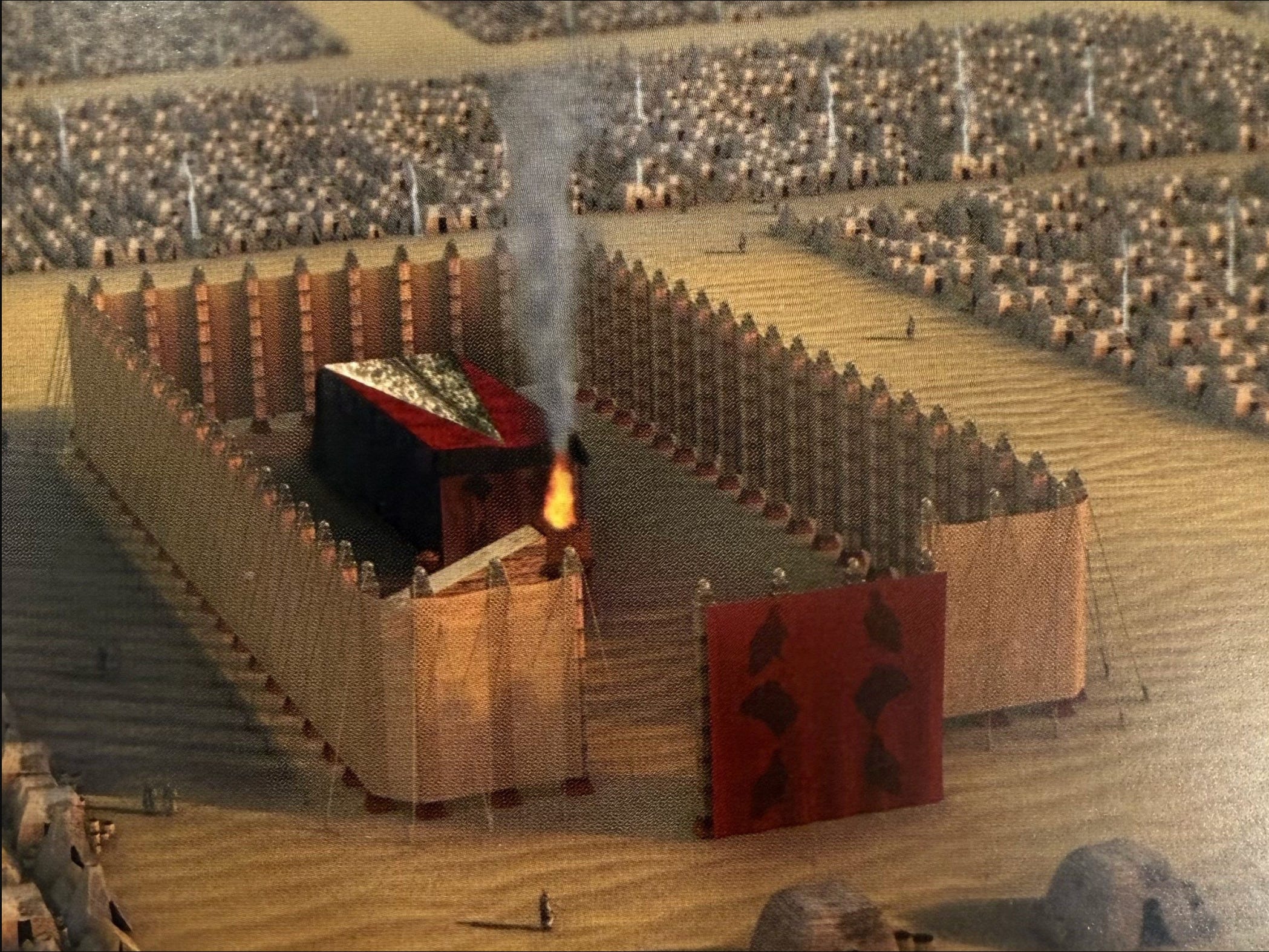
The Mishkan gave the people something concrete – a physical space, something to do with their hands and their eyes and their days. There were offerings for mistakes and rituals of return after failure. There were daily offerings, brought every morning and evening without occasion. And there were offerings of gratitude, brought simply in recognition of blessing.
The Mishkan as a structure made relationship possible not just in moments of crisis, but woven into the ordinary fabric of life – so that when the hard moments came, you hadn’t already drifted too far.
The Mishkan didn’t pretend that the Golden Calf hadn’t happened. It was built because of it. But it was also built on a frank acknowledgment that this relationship, across this distance, required permanent architecture – not willpower alone.
That is the model we need.
I can’t describe here the full program of what a Mishkan for the global Jewish people should look like. But some directions are clear enough.
Presence matters: my husband and I have committed to being in Israel at least twice a year, and bringing our children at least once. There is no substitute for being in the same room, the same city, the same ordinary Tuesday.
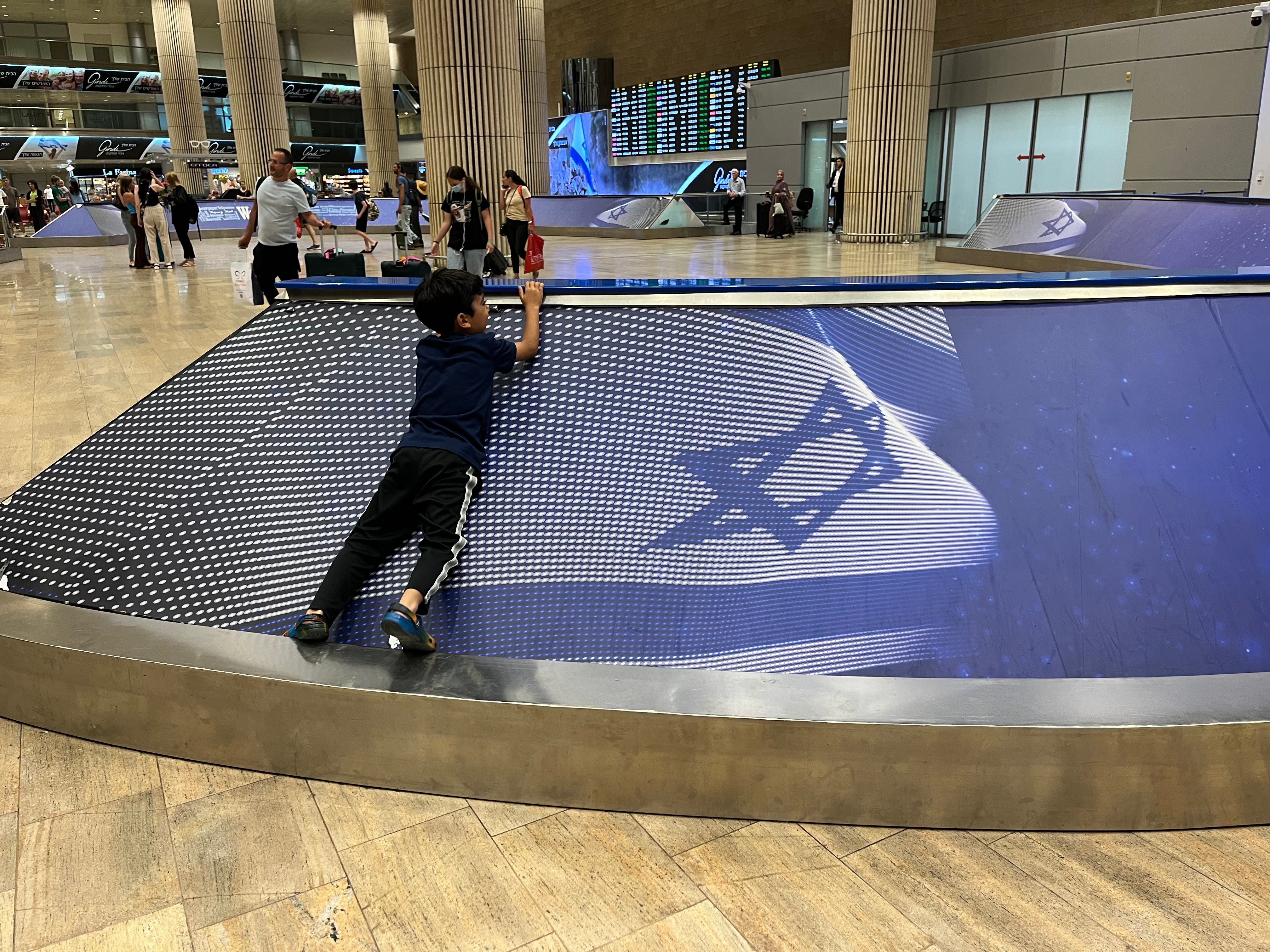
We need more programs that also bring Israelis into American Jewish life, not just send Americans to Israel – genuine back-and-forth, not one-directional pilgrimage.
Unmediated attention matters too. I follow Israelis on social media – I’m fortunate to speak Hebrew – and it changes things. Seeing someone post about their kids or complain about traffic, and then post about running to a shelter, does something a news headline cannot. There are plenty of Israelis posting in English for all of us to follow. We need to follow real people living real lives, and that needs to happen in both directions as well.
We also need to build something together. The Mishkan was a joint project – every tribe, every skill, every kind of contribution toward something shared. We don’t yet have an equivalent at the scale we need: serious bidirectional education, shared memory and curriculum built together, and clearer mutual aid infrastructure.
And we will also need to have some honest, uncomfortable conversations about differences that feel unbridgeable.
None of these exist at the scale we need yet. Building them is part of the work ahead of us.
But that is work for after. Right now, there is a war. So if you are a Jew living in relative safety, inspired by the Mishkan and what it represents, start small.
Before Shabbat, check in with five people you know in Israel. Put reminders in your calendar to check in every few days. Not a news check – a personal one. Send food to a family that is displaced or whose loved one is in the reserves. Donate to an organization providing mental health support or emergency response on the ground.
My good friends at JLIC Tel Aviv are supporting displaced families, soldiers and reservists; if you’re looking for a place to give, you can donate to them and note that you’re supporting emerging needs from this war.
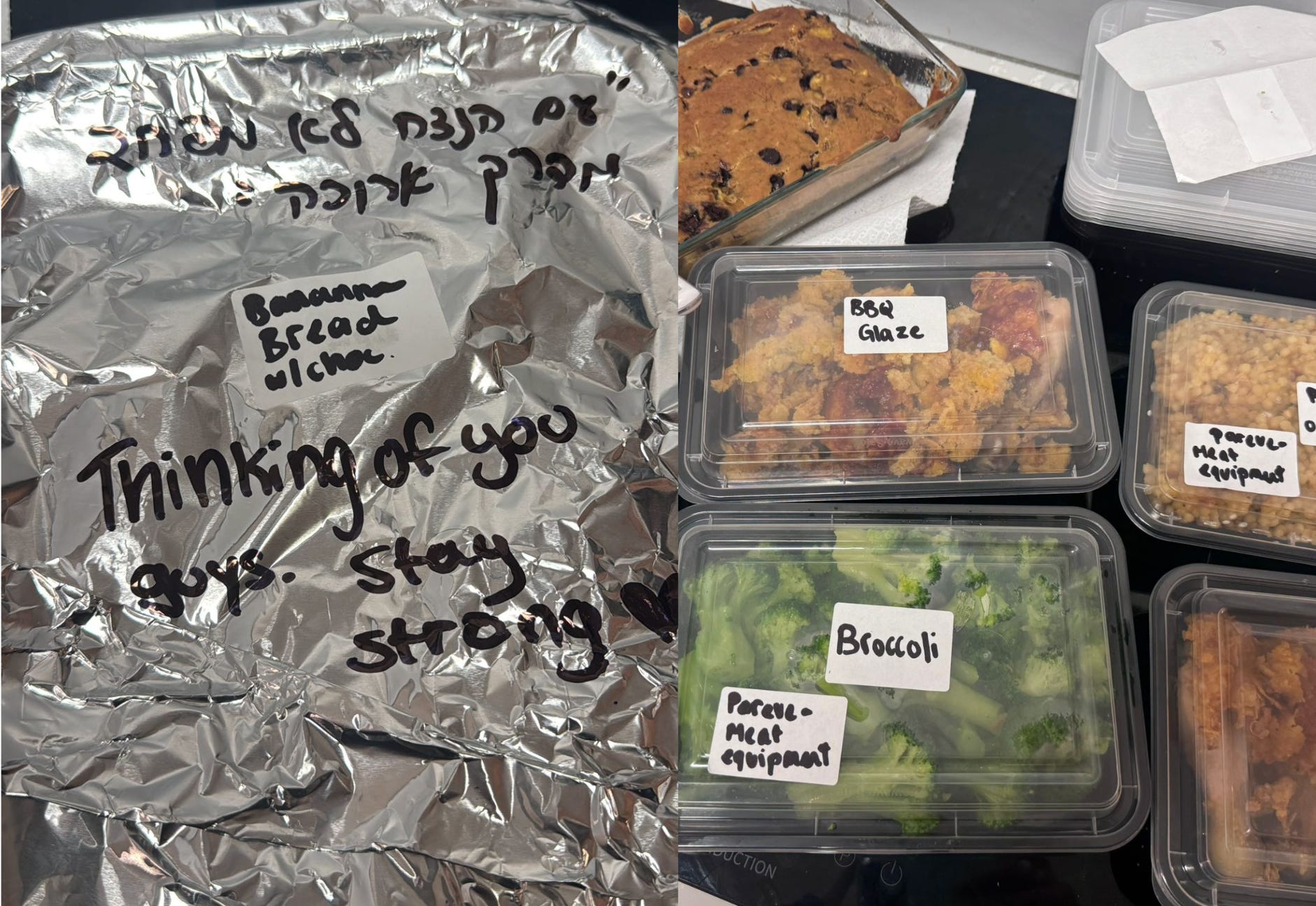
These are small things. They are also the things that build relationships over distance. The Mishkan’s magic was consistent, tangible acts of care, repeated day after day, that told the other side of the relationship: I see you. I am here. I have not drifted so far that I cannot find my way back.
The distance between us is real. So is the love. When this war is over, we owe each other the hard work that only people who intend to stay in permanent relationship across distance are willing to do.
But that will only be possible if we spend the time between now and then closing the distance, building our own mishkan – one check-in, one meal, one act of presence at a time.
Shabbat Shalom,
Mijal
Noam and I have been having some important conversations lately with leaders and scholars about antisemitism in America.
We recently spoke with Professor Jonathan Sarna, one of the foremost historians of American Jewish life, about how antisemitism has appeared in the United States across different eras. I was especially curious to ask him a question many American Jews quietly wonder about: are there warning signs that would tell us it’s time to pack our bags? You can listen to that conversation here. (audio)
We also sat down with Adam Louis Klein, who has emerged as an influential voice arguing that antizionism should be opposed as a phenomenon distinct from antisemitism. We asked him many of the questions people who’ve encountered his work are likely wrestling with. You can listen to that conversation here. (audio)

Author: Contributor
For more details on this author's background and expertise, please refer to the content within the article itself. The views and opinions expressed in this piece are those of the author and do not necessarily reflect the official policy or position of geula.news or its affiliates.