
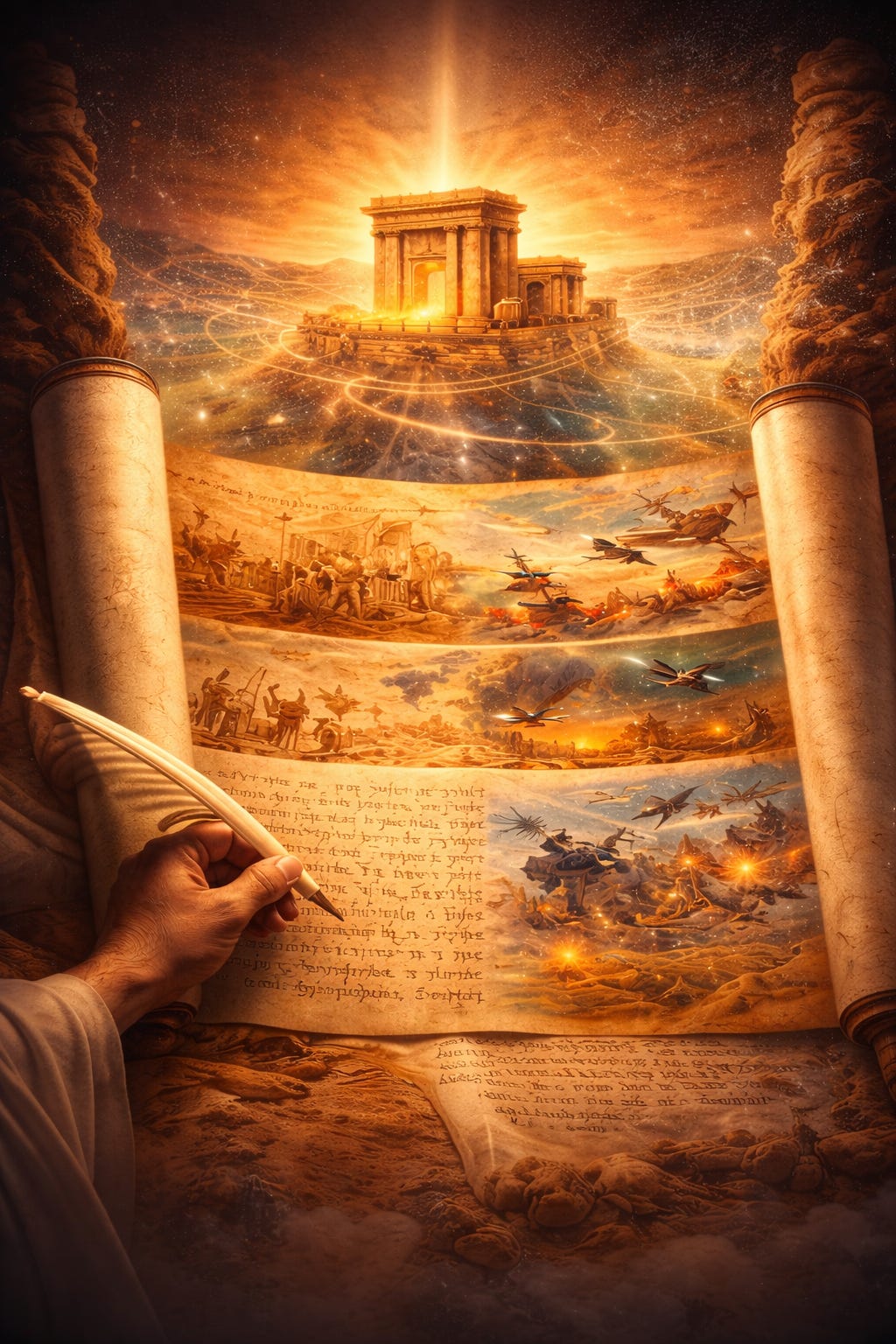
Why Rabbi Yosef Tzvi Rimon believes our generation may one day write a new megillah
By Rabbi Josh Wander
We have been trained to think of miracles only in their loudest form. We imagine seas splitting, empires collapsing overnight, plagues striking, pillars of fire guiding a nation through the desert. When we hear the word miracle, we instinctively think of the Exodus from Egypt. But Jewish history teaches something far more subtle: the greatest miracles are not always the ones that interrupt nature in spectacular fashion. Sometimes the greatest miracles unfold quietly, through the natural course of history itself. They appear as politics, wars, strange coincidences, and improbable sequences of events that only later reveal their deeper meaning.
Rabbi Yosef Tzvi Rimon has suggested something remarkable. In his writings he proposes that our generation may one day record the events we are witnessing as a new megillah — Megillat HaTekuma, the Scroll of Revival — describing the extraordinary chain of events that have reshaped Jewish history in our time.
This idea should not be as surprising as it first sounds. Throughout Jewish history, when the Jewish people experienced extraordinary salvation, those events were preserved in writing for posterity. The miracle of Purim was recorded in Megillat Esther, which contains ten chapters describing the dramatic reversal of Haman’s genocidal plan. The miracles of Chanukkah were preserved in Megillat Maccabeim, which recounts the astonishing military and spiritual revival of the Hasmonean revolt.
Yet there is an important detail that is often overlooked: when these miracles were actually happening, most people probably did not recognize them as miracles.
The story of Purim unfolded over many years. There were royal banquets, political intrigue, sleepless nights in the king’s palace, unexpected promotions, sudden reversals, and a series of events that looked, on the surface, completely natural. Only later, when Mordechai and Esther transcribed the story into a megillah, did the hidden pattern become obvious. Only then could the Jewish people see that what had appeared to be ordinary history was in fact a carefully orchestrated sequence of Divine providence.
Rabbi Rimon suggests that something similar may be happening in our own time.
If his framework is correct, then we may already be living inside the unfolding chapters of Megillat HaTekuma.
Megillat Esther contains ten chapters. Megillat Maccabeim contains twelve. My own theory is that the modern scroll Rav Rimon describes will likely contain a similar number. If that is true, then we may already be deep into the story, perhaps even approaching its final chapters while most of the world remains oblivious to what is actually taking place.
Rav Rimon outlines a chain of events that appear to form the early chapters of this unfolding narrative.
The first chapter begins far from Israel. The war between Russia and Ukraine appeared at first to be a distant European conflict. Yet it significantly weakened Russia, one of Iran’s major strategic partners, draining its resources and limiting its ability to support the regional axis aligned against Israel. What seemed unrelated to the Middle East quietly reshaped the geopolitical environment in which Israel’s enemies operated.
The second chapter unfolded within Israel itself. The judicial reform crisis, accusations of religious coercion, massive protests, and even threats by reservists and fighter pilots not to serve created the impression of a deeply divided nation. Israel’s enemies watched these developments carefully and concluded that the Jewish state had become weak and fractured. But what looked like national fracture would soon become the backdrop for an extraordinary moment of national awakening.
That awakening came in chapter three with the horrific events of October 7. The massacre itself was one of the darkest moments in modern Jewish history. Yet the attack exposed the broader plan of Israel’s enemies and revealed a coordinated effort to strike Israel from multiple fronts. At the same time, amid the horror, countless stories of survival emerged that defied explanation. Perhaps most significant of all, this was the first major pogrom against Jews in nearly two thousand years to occur when Jews were living in their own sovereign state with their own army responsible for their defense. This was not the helpless Jewish communities of exile. The Jewish people absorbed the blow and responded with unprecedented unity and determination.
Chapter four followed with one of the most extraordinary intelligence operations in modern warfare. Through the use of pagers and later walkie-talkies, Israel was able to penetrate Hezbollah’s communications network and severely damage its command structure. The operation ultimately led to the demise of Hassan Nasrallah and his senior leadership, delivering a devastating blow that essentially dismantled one of the most dangerous terrorist organizations in the world. For decades Hezbollah had threatened Israel with enormous military power. Within a short period of time its leadership was decapitated and its operational capacity severely crippled.
The fifth chapter came with the collapse of the Assad regime in Syria. In a development few analysts had predicted, the Syrian government was toppled by rebels and Syria’s hold over strategic territory, including areas around Mount Hermon, was broken. One of Israel’s most dangerous neighboring threats suddenly disappeared, and the regional balance shifted dramatically. At the same time, this development opened the strategic path toward confronting the central power behind the regional axis: Iran.
Chapter six involved preparation for that confrontation. Israel had very limited experience conducting sustained military operations thousands of kilometers from its borders. Yet the conflict with the Houthis in Yemen unexpectedly provided exactly that opportunity. Over the course of months, Israel developed the operational capabilities required for long-range strikes and complex regional coordination. What seemed like a peripheral conflict suddenly looked more like preparation for something much larger.
Chapter seven unfolded through the conflict with Yemen, diplomatic maneuvering through Qatar, and the painful return of hostages, both living and dead. The emotional toll on the Jewish people was immense, yet the very survival and return of many hostages was experienced by many as nothing short of miraculous. These events also sent a clear signal to the broader Arab world and to Hamas that Israel was prepared to take extraordinary measures in confronting evil.
All of this has now led to chapter eight: the direct confrontation with Iran itself. Only a few years ago, such a scenario would have seemed almost unimaginable. Yet today we are witnessing a reality in which Israel, the United States, and regional Arab allies are aligned against the central power behind the network of forces that have threatened Israel for decades. When viewed in isolation, each of these developments might appear to be merely another geopolitical event. But when placed side by side, they begin to form a chain so improbable that it is difficult to ignore the larger pattern.
This is precisely the perspective Rav Rimon is asking us to consider.
Perhaps the greatest challenge in recognizing miracles is perspective. When the sea split at the Exodus, the miracle was obvious. But when miracles unfold through history — through wars, intelligence operations, political upheavals, and unexpected alliances — they often remain hidden until the full story is written down.
That is why Purim required a megillah.
And that may be why our generation will one day need Megillat HaTekuma.
If the pattern of earlier megillot holds, the story is not yet finished. Eight chapters appear to have already unfolded. Two final chapters may still remain before the full meaning of these events becomes clear.
Most of the world is watching these developments as if they are simply another cycle of Middle Eastern instability. Even many Jews see them only as daily news headlines.
But future generations may one day read this period very differently.
They may open Megillat HaTekuma and discover that what looked like disconnected geopolitical events were actually the most extraordinary chain of miracles the Jewish people have witnessed in two thousand years.
And when they zoom out from the news and look at the entire story, they may reach a startling conclusion.
The miracles of our generation were not smaller than the miracles of the Exodus from Egypt. They were greater. Because the sea split once. But this story may be transforming the entire course of Jewish history.

Author: Joshua Wander
The Geula Movement inspires and mobilizes Am Yisrael to actively advance redemption through Torah, unity, and action—restoring Jewish sovereignty, rebuilding the Beit HaMikdash, and shining light from Zion to the nations. https://geulamovement.substack.com/