
Those who long for the Messianic era picture it vividly: the Third Temple standing again in Jerusalem, the tribes of Israel restored to their portions, peace flowing from Zion, and the King from the house of David ruling with justice. They read the prophets and see a future where the faithful live securely in the Land, participating in the redemption that has been promised for thousands of years. The excitement builds with every verse about gathering the exiles and rebuilding what was lost.
But the moment the conversation turns to those who join themselves to the people of Israel and their descendants in that restored kingdom, the details matter. Tribal identity, inheritance of land, and service in the Temple follow fixed biblical rules. Those rules do not shift for zeal or declarations of loyalty.
Here is the question every person drawn to the Messianic era needs answered directly: What can someone who fully enters the covenant and his family truly inherit and accomplish in the coming redemption, and what remains permanently out of reach?
The Bad News Comes First – Hang with Me, It Gets Better
Start with the men who enter the covenant through conversion. A male righteous convert, known as a ger tzedek, and every son in his line hold no claim to priesthood or Levitical service. The Sages state plainly that the convert enters the covenant as a newborn, like Abraham our father, with no ancestral chain from Aaron or Levi. Priesthood belongs exclusively to the sons of Aaron. Levitical status passes only through the male line from Levi. DNA markers offer no halachic standing; verification comes from documented tradition alone. The Mashiach may assign or confirm tribal affiliations using prophetic insight or the restored Urim ve-Tummim, but this confirmation applies to existing Israelite lineages. For the ger tzedek, who stands equal to Abraham in covenant entry, assignment adds a bonus at most. The blessings already run deep without it.
A resident in the Land who has not entered the covenant, called a ger toshav, carries fewer obligations. He lives securely among the tribes with protections such as support in poverty and the right to reside in the Land. The Torah permits giving him an animal that died without proper slaughter: “You shall not eat anything that dies of itself. You may give it to the stranger who is within your gates, that he may eat it, or you may sell it to a foreigner” (Deuteronomy 14:21). A slaughter that did not go as planned becomes permitted biblically to the ger toshav. He bears lighter responsibilities under the law and remains not bound to the same level of commandments as Israel.
His offerings to the Temple are accepted. The Torah states: “If a stranger sojourns with you, or whoever is among you throughout your generations, and he wishes to offer an offering made by fire, a sweet savor to the Lord, as you do, so shall he do” (Numbers 15:14). Yet he may not pass the soreg, the low barrier separating the outer court from the inner courts. His offering is brought to the priests at the outer area and placed on the altar on his behalf, but he himself stays beyond that boundary. This separation is not a man-made invention. The boundary around Mount Sinai was God-ordained from the beginning: “You shall set bounds for the people round about, saying: Take heed to yourselves, that ye go not up into the mount, or touch the border of it; whosoever toucheth the mount shall surely be put to death” (Exodus 19:12). The same principle protects the holiness of the Temple courts in the future.
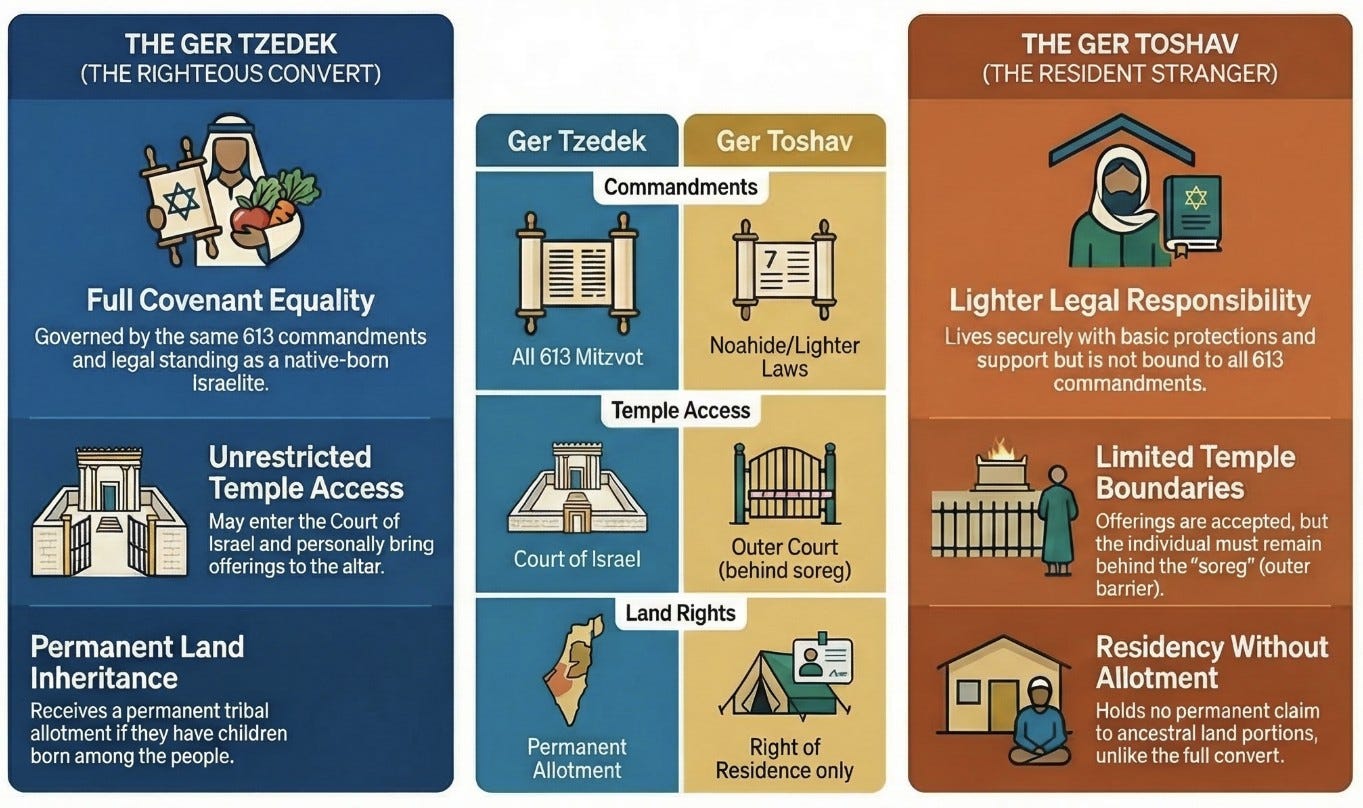
The bad news sounds heavy at first, but stay with me because the reality proves far less burdensome than it appears. Hashem places no unnecessary yoke on the ger toshav or the ger tzedek. A resident in the Land carries lighter responsibilities and enjoys greater blessing than any righteous person dwelling among the nations. The ger tzedek receives full covenant standing: he observes all 613 commandments, stands in the Court of Israel mere feet from the avodah (service) and the altar, brings offerings personally, participates in the festivals without restriction, and lives as an equal Israelite in every general right.
The Torah commands repeatedly to love the ger: “You shall love him as yourself, for you were strangers in the land of Egypt” (Leviticus 19:34). The Sages derive from these verses that converts hold a special place, as dear to Hashem as the day the Torah was given at Sinai. The blessings of dwelling where the Shechinah rests, eating from the land’s produce in holiness, and witnessing the redemption up close make any exclusion from hereditary roles pale in comparison.
This Is Very Good News – The Stranger Is Equal
One law governs the native-born and the ger who enters the covenant: “One ordinance shall be both for you of the congregation, and also for the stranger that sojourns with you, an ordinance forever in your generations: as you are, so shall the stranger be before the Lord. One law and one manner shall be for you, and for the stranger that sojourns with you” (Numbers 15:15-16). In covenant terms, not mere residency, the Torah calls this convert ha-ger in the same way it describes Abraham himself – a sojourner without tribal affiliation who enters the covenant fully. “As you are, so shall the stranger be” means equality in every covenant obligation and privilege, modeled on Abraham our father who had no ancestral claim yet became the father of the nation.
The word “stranger” sounds second-class, like slave or servant. The Bible uses it differently. In this verse the ger is the ger tzedek who has entered the covenant fully, not the ger toshav who sojourns among the people without conversion. The ger tzedek stands equal before Hashem, equal in law, equal in Temple access, equal in standing among the people. This is not lesser status. This is full membership in Israel.
The prophet Isaiah speaks directly to this inclusion in the future Temple: “Also the sons of the stranger, that join themselves to the Lord, to serve Him, and to love the name of the Lord, to be His servants, every one that keeps the Sabbath from profaning it, and takes hold of My covenant; even them will I bring to My holy mountain, and make them joyful in My house of prayer; their offerings and their burnt offerings shall be accepted upon Mine altar; for My house shall be called a house of prayer for all peoples” (Isaiah 56:6-7). The offerings of the ger tzedek rise on the altar in the Third Temple, bringing joy in the house of prayer.
The awaited Messiah King must come from the verified patrilineal line of David to fulfill the prophecies of justice and restoration. The Bible names Cyrus a mashiach in one context for his role in ending the Babylonian exile and enabling the Second Temple, yet he was a Persian king, not from the house of David. The verse states directly: “Thus says the Lord to His anointed (limshicho), to Cyrus, whose right hand I have held, to subdue nations before him” (Isaiah 45:1). God called him “My Messiah” (mashiach), yet he was a foreign ruler. The role we await demands the specific Davidic descent from the tribe of Judah. No external sign overrides that requirement.
Land Inheritance in the Restored Era
In the days after Joshua, only patrilineal descendants of the twelve tribes held ancestral portions that reverted in the Jubilee year. A male ger tzedek could buy property, but it returned to the original tribal family. The ger toshav held no permanent claim at all.
The future changes the equation decisively. The prophet Ezekiel describes a permanent allotment for the ger tzedek who has children born among the people: “You shall allot it as an inheritance for yourselves and for the strangers who reside among you who have begotten children among you. They shall be to you as native-born among the children of Israel; with you they shall be allotted an inheritance among the tribes of Israel. And it shall be that in whatever tribe the stranger resides, there you shall give him his inheritance, declares the Lord God” (Ezekiel 47:22-23). Residence among a tribe determines his share, treating him exactly as native-born for that purpose. The Sages explain this as the mechanism for converts to receive land in the messianic division, sometimes described as a thirteenth portion or land contributed by the tribes. Female converts and their families qualify under the same provision.
The holy portions for Kohanim and Leviyim remain reserved for verified bloodlines, as chapter 48 specifies: “It shall be for the priests, the sons of Zadok, who kept My charge…” (Ezekiel 48:11). The Mashiach confirms those lines without exception. Yet the broader tribal allotments open to the ger tzedek with children make full belonging possible.
The Door Stands Open Wider Than Many Imagine
Those who long for the Messianic era find the path clearer than they expected. Enter the covenant fully, dwell in the Land, raise children among the people, and the prophets promise inheritance among the tribes. The exclusions protect the hereditary lines established by Hashem; the inclusions welcome the righteous who join Israel. Live in the Land under full observance, stand in the Court of Israel, offer in the Temple, and receive land in the restoration. The blessings outweigh any closed gate. The coming redemption rewards those who walk the path the Bible lays out without deviation.
If this speaks to you and you feel drawn to the covenant with its 613 commandments, or if it is right for you, the door stands open. Conversionjudaism.com provides guidance for those who wish to pursue it. Stopping short and remaining a righteous person among the nations is also wonderful and carries real blessing. Yet for those pulled toward full entry into Israel, the path is there.

Author: Yosef Eitan
Yosef Eitan is an Orthodox Jewish writer based in the United States, focusing on geopolitics, U.S.-Israel relations, and Jewish thought. Founder of Mishnah Walk and Conversion Judaism, a student of classical Jewish sources and Temple Tavnit studies. ConversionJudaism.com