
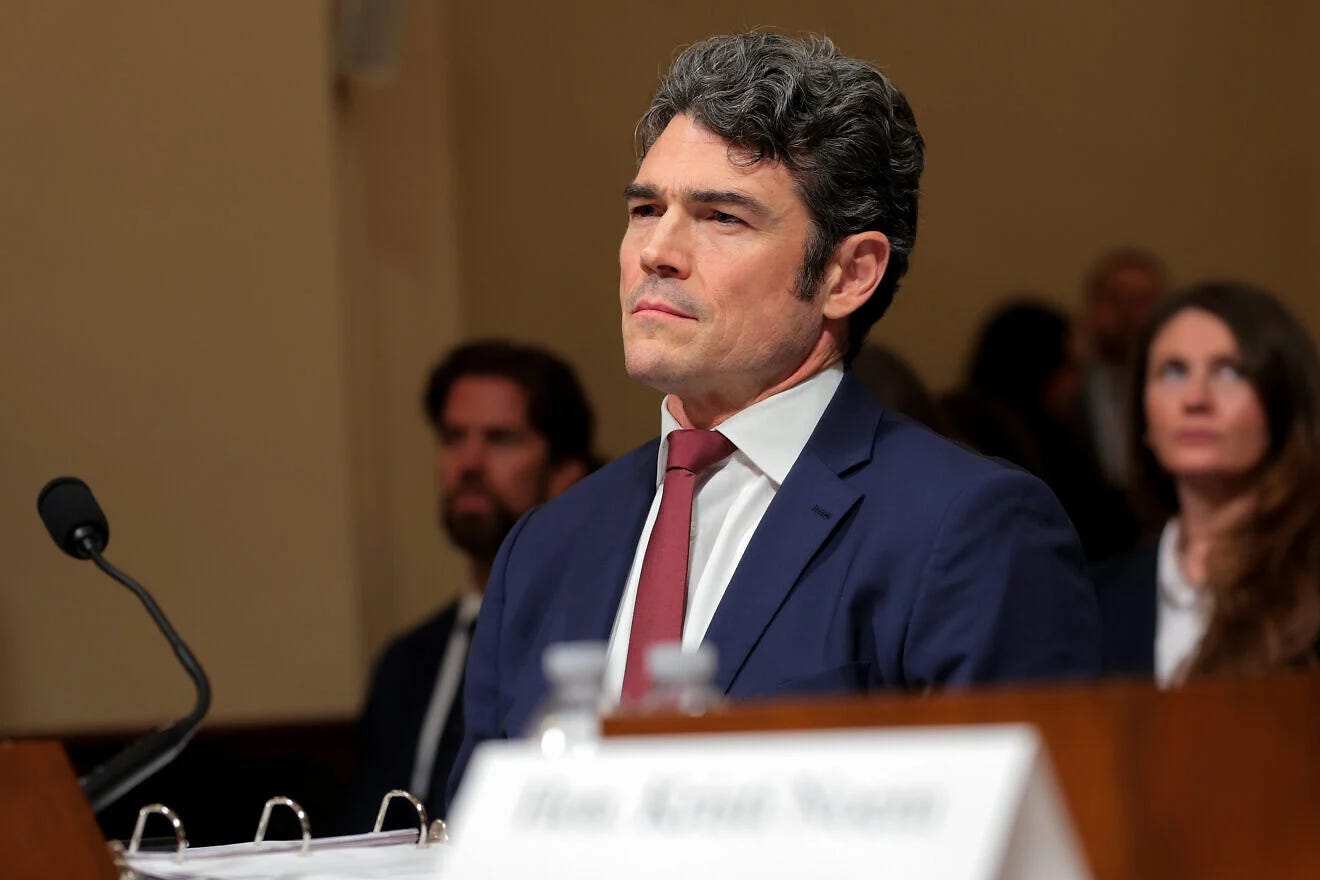
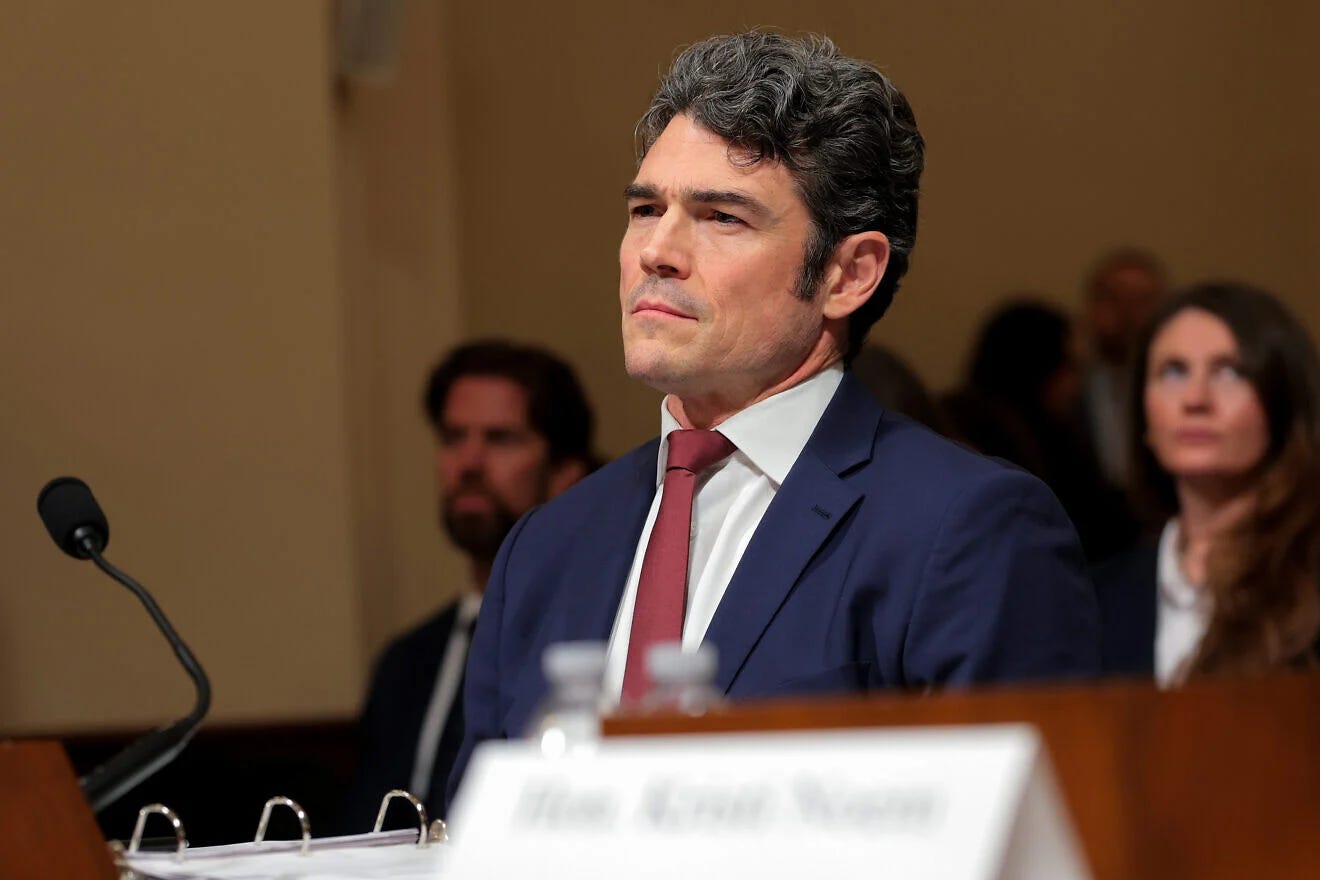
Director of the National Counterterrorism Center Joseph Kent testifies before the House Committee on Homeland Security in the Cannon House Office Building on Dec. 11, 2025 in Washington, DC. Photo by Anna Moneymaker/Getty Images
by Rachel O’Donoghue
(Honest Reporting) — Within hours of publishing his resignation letter on X, Joe Kent, the Director of the National Counterterrorism Center, had reached millions.
The media, predictably, was enthralled.
“‘Iran posed no imminent threat to our nation’: Trump-appointed intelligence official resigns over Iran war,” CNN blared.
Axios followed suit, presenting Kent’s claims with little skepticism: “‘No imminent threat’: U.S. Counterterrorism Center head resigns over Iran war.”
The same media outlets now treating Kent as a credible whistleblower were, until recently, describing him very differently.
The Hill amplified another conspiratorial voice, headlining Tucker Carlson’s warning that “neocons” would now try to destroy Kent.
The New York Times published multiple pieces within hours, including one that packaged his resignation letter as a standalone piece.
Readers were invited to see Kent’s words as a serious, insider indictment of both the war against Iran and President Donald Trump’s administration itself.
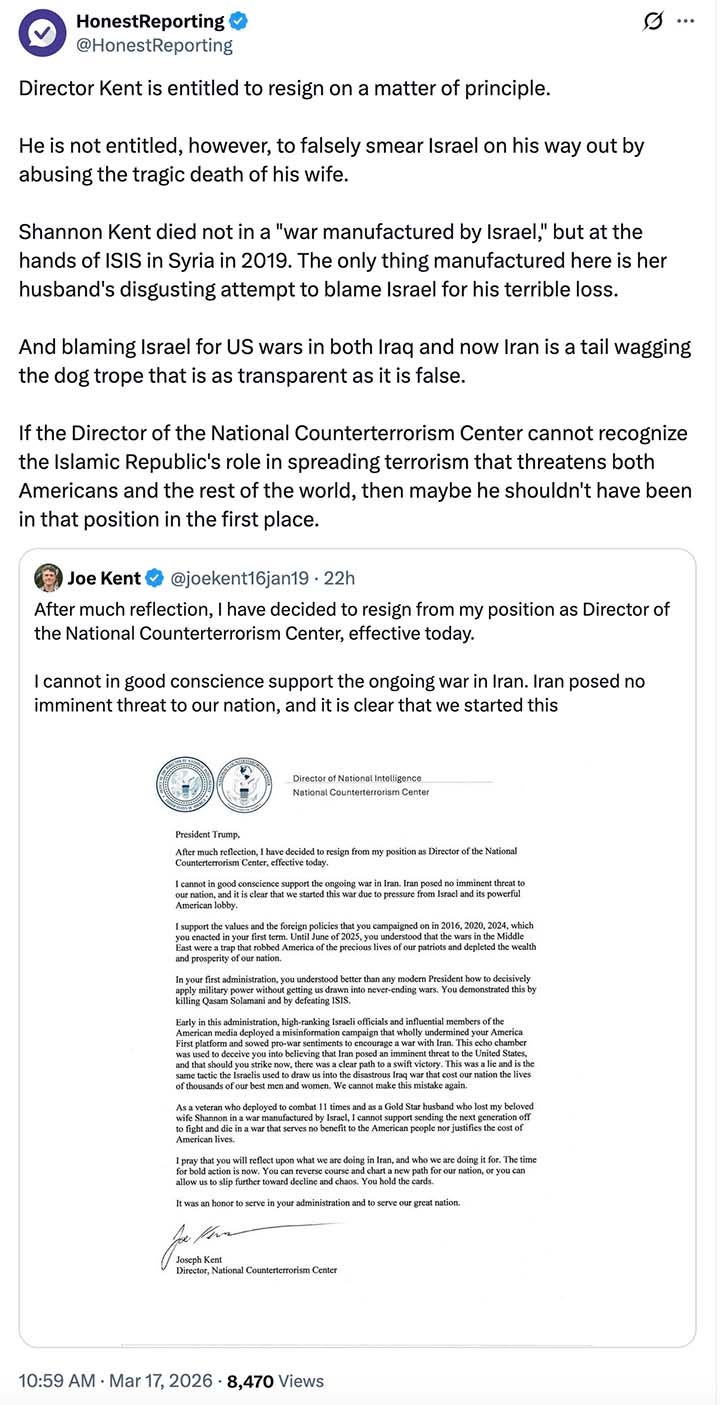
After all, this was a man personally appointed by the president, working under Director of National Intelligence Tulsi Gabbard.
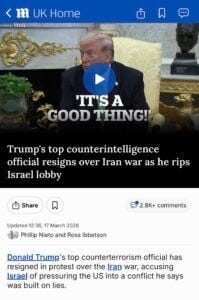
The Daily Mail went further still, elevating Kent’s rhetoric about the “Israel lobby” in a headline that nodded to one of the oldest conspiratorial tropes in circulation.
The Associated Press soberly reported that Kent had resigned because “Iran posed no immediate threat.”
Across outlets, the framing was clear: Kent was to be taken seriously.
His claims – that the war was driven by Israel and its American “lobby,” that Trump had been “deceived,” and that Iran posed no imminent threat – were not meaningfully interrogated, but simply transmitted.
Even his more outlandish assertions were handled with care.
Kent claimed that his wife, Shannon, had died in a “war manufactured by Israel.”
In reality, Shannon Kent was killed in Syria in 2019 by an ISIS suicide bomber, a fact Kent himself stated plainly in a 2020 NBC op-ed. That article did not mention Israel once.
Apparently, it is only in retrospect that Kent has decided ISIS – an Islamist terrorist group that broadcast from the Syrian desert the executions of Western hostages – was somehow a product of Israel.
Yet even here, major outlets softened the reality.
NPR avoided stating how she was killed, noting only that she “died serving in Syria in 2019.”
The BBC similarly declined to mention ISIS, reporting merely that she “was killed in a bombing in Syria.”
This is how credibility is quietly manufactured: not through explicit endorsement, but through omission.
But there is a deeper problem.
Because the same media outlets now treating Kent as a credible whistleblower were, until recently, describing him very differently.
When Kent first entered national politics, his record was viewed – quite rightly – as something far more troubling.
Kent, 44, has twice run unsuccessfully for Congress in Washington state.
During his 2022 campaign, he gave an interview to a neo-Nazi YouTuber who had praised Adolf Hitler as a “complicated historical figure.” He also engaged with figures from white nationalist circles and reportedly complained that America was “anti-white.”
He sought support from Holocaust denier and white supremacist Nick Fuentes during a GOP primary. Though Kent later attempted to distance himself, the outreach itself was not in dispute.
His campaign drew endorsements from figures like Paul Gosar, who has long associated with white nationalists, and Marjorie Taylor Greene, who has a long and well-documented history of antisemitic rhetoric. His website also featured support from Arizona state senator Wendy Rogers, who was later censured after appearing at a white nationalist conference and invoking anti-Jewish tropes.
Kent even hired a member of the Proud Boys as a campaign consultant.
At the time, much of the media covered this record in detail.
CNN itself reported extensively on Kent’s “past association with extremists” and his interactions with Nazi sympathizers and Holocaust deniers.
Now, that same outlet reduces this history to a paragraph that references his “past associations with far-right figures became a key issue,” while dedicating far more space to his peddling of conspiracy theories about the murder of Charlie Kirk.
The Daily Mail omitted it entirely, opting instead to highlight his “decorated military career” and a spat with Laura Loomer.
Equally absent from much of the coverage was the extent to which Kent’s claims were rejected across the political spectrum. Rep. Josh Gottheimer pushed back publicly, while White House press secretary Karoline Leavitt directly called his central claim – that Iran posed no imminent threat – “false,” stressing that President Trump had “strong and compelling evidence” of an impending attack.
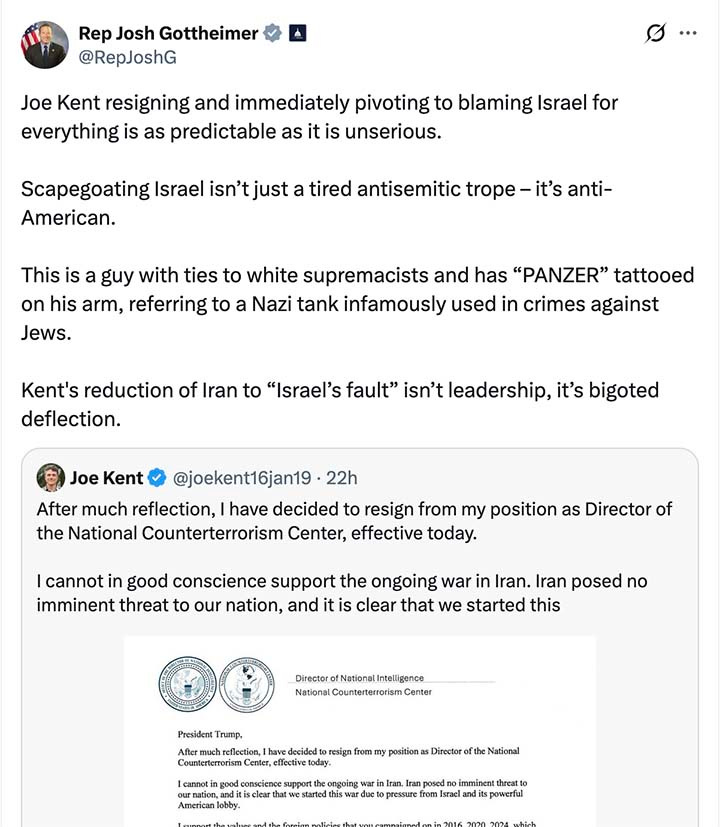
In other words, the man has not changed; he is still peddling the same absurd conspiracies as he always has.
What has changed is the media’s willingness to contextualize him.
When Kent was politically inconvenient, his extremism was central to his identity.
Now that his claims can be used to undermine a war involving Israel – and, by extension, the Trump administration – that same extremism is quietly set aside.
The result is that a figure once treated as beyond the pale is suddenly recast as a credible authority on matters of national security and foreign policy.
His claims are not strengthened by evidence, but by the selective amnesia of the outlets amplifying them.
And the public is left with a dangerously distorted picture: not just of Joe Kent, but of the issues he is now being used to comment on.
Because when the media decides who is credible based not on consistency, but on convenience, it does more than mislead.
It erodes the very standard by which credibility is judged in the first place.
Born in London, England, Rachel O’Donoghue moved to Israel in April 2021 after spending five years working at various national newspaper titles in the UK. She studied law at the University of Law, London, and gained a master’s degree in multimedia journalism at the University of Kent. This article first appeared in Honest Reporting.

Author: Contributor
For more details on this author's background and expertise, please refer to the content within the article itself. The views and opinions expressed in this piece are those of the author and do not necessarily reflect the official policy or position of geula.news or its affiliates.