

By Rabbi Josh Wander
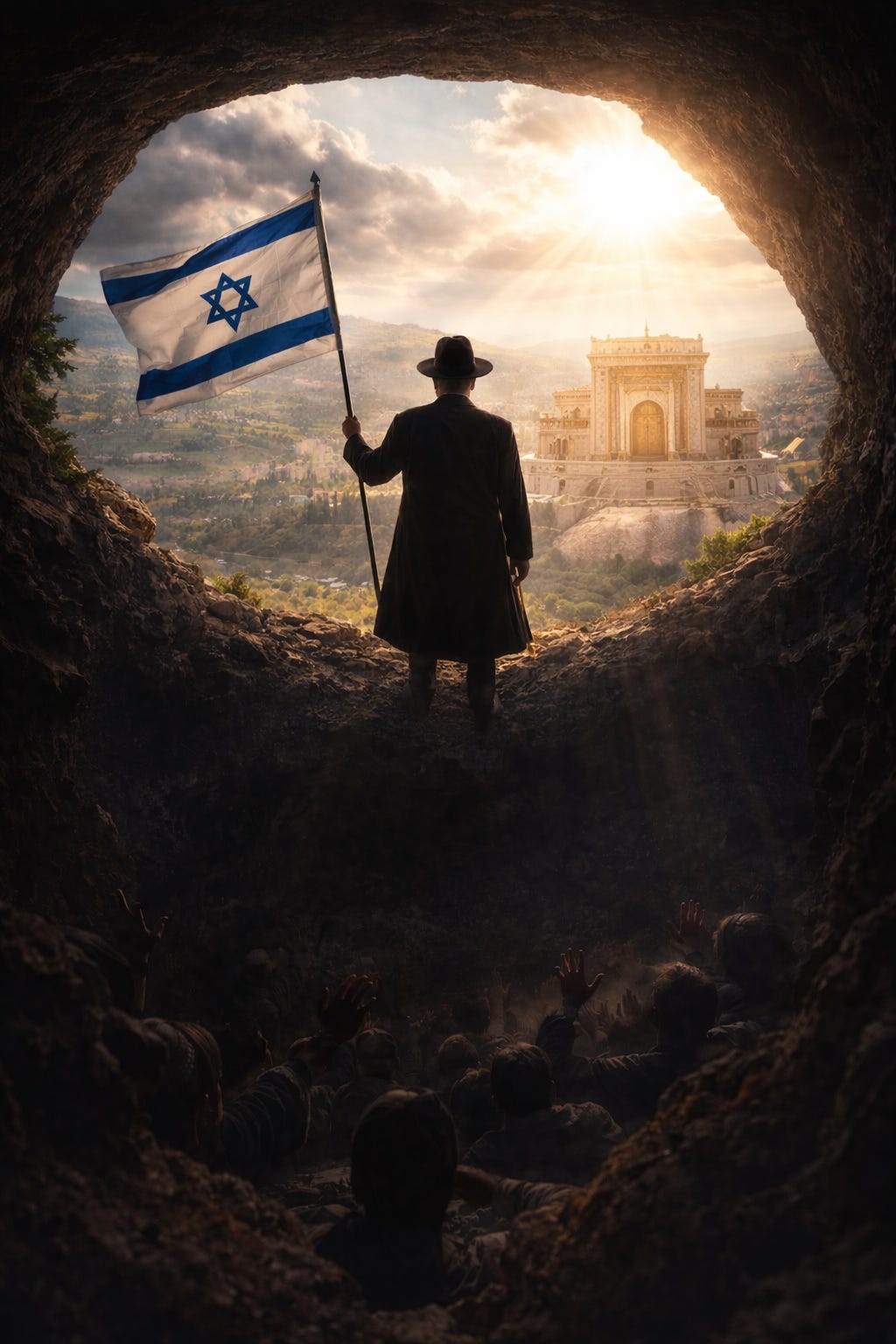
A good friend, Reuvain P., sent me a parable from the book “Living Lessons from Tanya”: A poor family was once thrown into a pit by an evil poritz. Years passed, and the family had children, and then those children had children themselves.
Eventually, there came a time when the descendants of the original family began to doubt whether there existed a world outside their pit; they had never seen any other world. Their parents, too, knew nothing of a world outside the pit. The only evidence they had for a world that wasn’t small, dark and cold was an old legend that had been passed down through the generations. Some members of the pit believed the tradition, others denied it. “There is no such thing as trees, there is no such thing as the sun!” they argued, “it’s all a fantasy!”
One day, something surprising happened—a man fell into the pit! He began to tell them of the world outside. He described sunshine, trees, grass and blue skies. He spoke with conviction and strength, painting a vivid picture of life outside the pit. After hearing him speak, even the most hardened cynics were forced to concede that there was, indeed, a world outside their tiny space.
We are all like that poor family. Our neshamot originate from a world of light and truth—the rich and vast world of G-dliness. They are then sent down into a cold dark pit—our world, where the light and truth of Hashem is hidden. We become so distant from the true reality that we begin to think that our small world is the only truth. Some people go so far as to claim that the true reality, the reality of Hashem, doesn’t even exist. Even those who believe that Hashem exists, see it as a far off abstraction, miles away from real life.
And then someone enters our pit from the world outside. A Rebbe enters the pit but remains beyond it. His reality is the truth of Hashem; he still lives in the world of truth. While to us, Olam Hazeh is all there is, to the Rebbe, Olam Hazeh resembles a small dark pit compared to the vast, light-filled world beyond it. Hashem sends us a Rebbe, someone from outside the pit, to give us a glimpse of that reality.
That is not just a story. That is exactly how I feel every single day.
There is a strange and heavy awareness that comes with seeing something others do not. It is not arrogance. It is not even certainty in the conventional sense. It is simply the inability to pretend that the pit is all there is once you have seen the light beyond it. And that is the tension I live with constantly.
Because today, the “world outside the pit” is not some abstract spiritual realm alone. It has taken on form. It has geography. It has substance. It is called Eretz Yisrael.
For nearly two thousand years, Jews sat in the darkness of exile and spoke about it the way those in the pit spoke about the sun—something distant, something almost mythical. “Next year in Jerusalem.” Words repeated so often that they risked becoming just that—words. A tradition passed down, believed by some, dismissed by others, but rarely lived.
And now? Now the man has fallen into the pit. The Land is alive. The gates are open. The Jewish people are returning home in numbers that would have been unimaginable to previous generations. The barren land has flourished. A sovereign Jewish presence stands where for centuries there was none. History is not being remembered—it is unfolding. Redemption is no longer a promise whispered in the dark. It is a process happening in real time. And yet, so many remain in the pit.
They hear about Eretz Yisrael, they visit it, they even feel inspired by it—but then they return “home” to exile and continue living as if nothing has fundamentally changed. They build comfortable lives, strong communities, beautiful institutions…all within the walls of the pit. And when you try to describe what is happening—when you speak about Geula not as a future event but as a present reality—you are often met with the same response echoed in that parable: “It’s not real.” “It’s not practical.” “It’s not for us.” In modern language, but the same idea—there is no sun, no trees, no world beyond this.
But I have seen it. I live it. And once you do, you cannot go back to pretending otherwise.
That is why this parable resonates so deeply with me—not only because it describes the human condition, but because it describes a role. The man who falls into the pit and begins to speak. The one who tries, however imperfectly, to put into words something that others have never experienced. The one who is met with resistance, skepticism, even ridicule—and yet continues to speak because the truth is too real to stay silent.
I don’t claim perfection in that role. But I recognize it. To live in Eretz Yisrael today is to stand with one foot inside the pit and one foot outside of it. To see the contrast so starkly that it becomes impossible to ignore. The noise of exile, the assumptions of exile, the comfort of exile—they begin to feel like shadows compared to the clarity of what is unfolding here.
Geula is not a fairy tale. It is not a metaphor. It is not a line at the end of a prayer. It is happening!
And the real tragedy is not that the pit exists. The tragedy is that so many have grown comfortable inside it, even as the light pours in from above.
So what do you do when you see it?You speak. You point upward. You refuse to let the legend remain just a legend. Because there is a world outside the pit. A real one. A living one. A calling one.
Some will hear it—and climb.
The rest will continue to argue about whether the sun exists.