

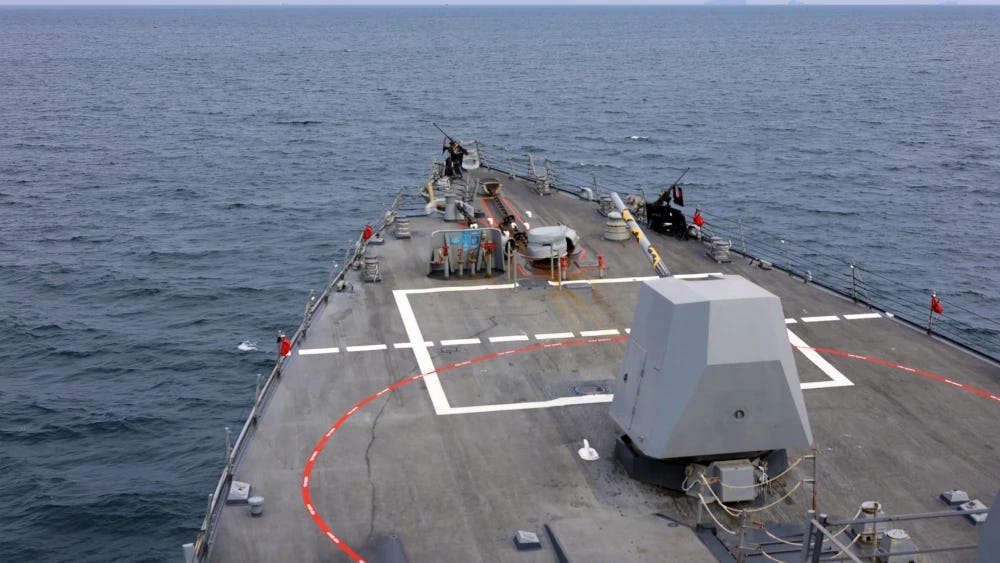
The Arleigh Burke-class guided-missile destroyer USS “Roosevelt” (DDG 80) transits the Strait of Hormuz in the U.S. Central Command area of responsibility, Dec. 5, 2025. Credit: Mass Communication Specialist 1st Class Indra Beaufort/U.S. Navy.
by Shay Khatiri
(CAMERA) — According to reports, the Department of Defense is planning on asking Congress for a $200 billion supplemental for Operation Epic Fury. This has sparked a series of misleading headlines and articles.
On Mar. 19, the New York Times published a report entitled “Pentagon Seeks $200 Billion to Fund Iran War.” The next day, Jesus Mesa wrote for Newsweek claiming that the $200 billion “figure is roughly $67 billion more than Bush asked Congress for when the Iraq invasion began on March 19, 2003.”
The administration has not yet submitted a formal request. Reporters are thus writing without substance. A lack of familiarity with the Pentagon’s budgetary schemes and national security in general has only further eroded the accuracy of their coverage.
First, we should look at the cost of the war thus far. According to former Pentagon comptroller Elaine McCusker, the cost of the war, “including positioning maritime and aviation assets in the Middle East starting at the end of December, is between $16.2 and $23.4 billion.” Mark Cancian at the Center for Strategic and International Studies estimated that the average daily cost of the war in the first 12 days was $891.4 million. According to Politico, congressional Republicans estimate that the war is costing close to $2 billion a day, the highest figure yet. This estimate likely includes damage repair, such as for the Terminal High Altitude Area Defense (THAAD) battery hit by Iran and the USS Gerald R. Ford, which caught fire during its deployment.
There are three explanations for the $200 billion request. The first one is that the administration is planning for a major escalation that will drive up the daily cost of the war, which no press reporting confirms. Second, the administration could be planning for an extended campaign, which contradicts American and Israeli statements that the coalition is ahead of schedule in eliminating targets. The third explanation is that the $200 billion number is mostly not about the Iran War.
Supplemental packages typically include unfunded priorities of civilian agencies and military services. These are line items unsuccessfully sought in their previous budget requests. Consider the last national security supplemental package, enacted in 2024. On the surface, its purpose was to aid Ukraine and Israel during their respective wars. In reality, it also allocated money to refugee resettlement programs for USAID; AUKUS, a trilateral agreement among the United States, the United Kingdom, and Australia to help provide Australia with the necessary technology to produce nuclear-powered, silent, attack submarines; and boosting the defense industrial base production for the defense of Taiwan.
On Mar. 12, before the reports concerning the $200 billion supplemental reqeust came out, Acting Pentagon Comptroller Jules Hurst tacitly confirmed this point. Speaking on a panel at the Reagan Institute, Hurst stated that there would be a supplemental package request sent to Congress, adding, “So not just replacing things, but buying new things, right? New entrants, looking at that.” The likely case is that these “new things” will include items not intended to be used during Operation Epic Fury but with China and Russia in mind.
But even this is a prediction. We will not know what the administration will ask Congress, and we will only know how long the war will have lasted when it is over. To determine the length and cost of the war in advance is misguided. Journalists should wait for the facts instead of presenting speculation as fact.
Originally published by the Committee for Accuracy in Middle East Reporting and Analysis.