
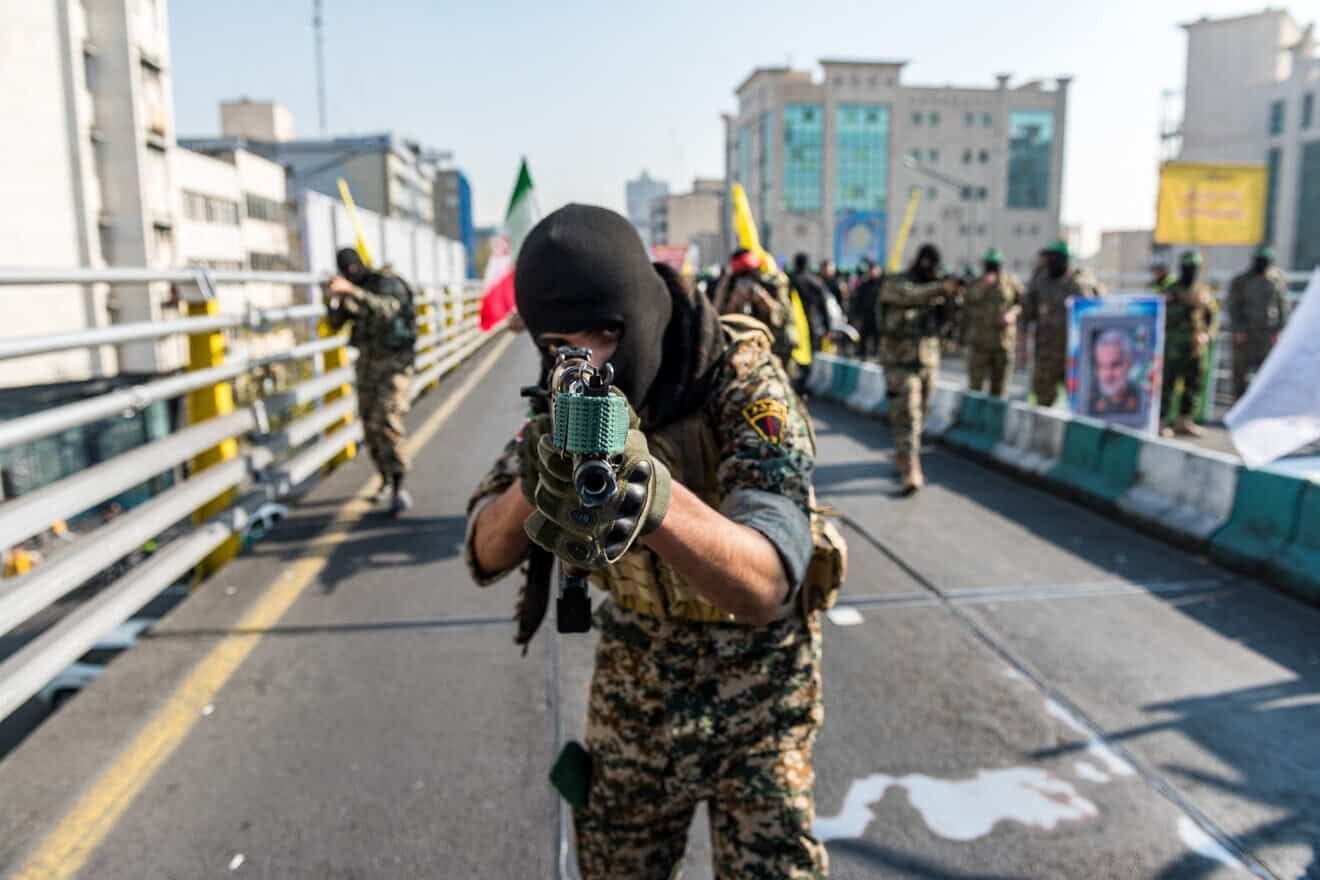
A Basij militiaman aims an AK-47 at the camera during a parade of a claimed 110,000 paramilitary Basij and Islamic Revolutionary Guard Corps terrorists in downtown Tehran on Jan. 10, 2025. Photo by Hossein Beris/Middle East Images/AFP via Getty Images.
by Jennifer Kouzi
(CAMERA) — In a bafflingly named Mar. 11, 2026, segment by NPR entitled “Who are Iran’s Revolutionary Guard Corps [IRGC] and what’s their aim?” NPR managed to answer neither question.
Imagine a segment entitled “Who is Al Qaeda [or ISIS] and what’s their aim?” and not using the words “terror(ism)” or “Islamic fundamentalism” in the discussion. That’s what NPR did when “explaining” the IRGC.
NPR reporter Arezou Rezvani spoke with Ali Alfoneh, a senior fellow at the Arab Gulf Institute in Washington, whom Rezvani described as one of the foremost experts of the IRGC. Rezvani reported that Alfoneh believes the U.S. and Israel “miscalculated the group’s strength” and didn’t fully appreciate its structure.
In fairness, most of the “description” of the IRGC was recited by Rezvani, so Alfoneh cannot be blamed for not explaining “Who are [the IRGC]?” Rezvani reported the IRGC has roughly 150,000, mostly lower-middle-class members, the majority of whom are paid $300 per month. She added further that the IRGC controls oil, construction, energy, and telecommunications sectors. Alfoneh chimed in that the IRGC had become an example of corruption in the Islamic Republic – a business conglomerate hoarding wealth.
Rezvani did state that during the present military conflict, the IRGC had launched retaliatory strikes and hit military bases, embassies and hotels across the region (notably omitting attacks on civilians in Israel), and reported that “analysts” do not expect the IRGC to surrender. In a very limited sense relating just to the present military conflict, Alfoneh speculated as to the aim(s) of the IRGC: to prolong the war, make it regional and expensive, and impact the price of oil in the global markets. Apart from that, nothing in the segment actually explained what the IRGC is or what its aims are beyond this war.
The IRGC is a military unit established in 1979 to handle internal and external security, suppress opposition groups and advance the goals of the revolution: an Islamic state. The corps was created as a counterforce to Iran’s traditional army, which the original post-revolution leadership did not trust. Because it reports directly to the Supreme Leader, the IRGC operates outside the law and the courts, bypassing the president.
The corps is inspired by a “mix of fundamentalist Shiism and revolutionary Marxism.” It was founded on the principle that it would not only guard strict Shia Islamist principles in Iran, but that it also sought global revolution. The IRGC’s fingerprints have been found beyond the Middle East in all continents but Antarctica. A sampling: terror attacks in Argentina, plots on diplomats in Thailand and India, terror plots in Kenya, plots targeting UK citizens and residents, arson attacks in Australia, assassination plots in the United States and Mexico, and terror plots in Senegal and Uganda.
Branches of the IRGC include: ground forces; the Basij paramilitary force, a “plainclothes militia” that suppresses dissent and engages in morality policing; a naval force, separate from the regular Iranian military, that patrols the Strait of Hormuz and other maritime borders; an aerospace force, also separate from the regular military, which runs the ballistic missile program; and a cyber command responsible for military and commercial espionage and the distribution of propaganda. The most notorious branch of the IRGC is the Quds Force – Iran’s main mechanism for supporting terrorist proxy militia groups in Iraq, Lebanon, Syria, Yemen, Gaza, and the West Bank, including Hezbollah, Hamas and the Houthis.
IRGC members established training camps in Lebanon in the early 1980s and committed tens, if not hundreds, of millions of dollars to create Hezbollah. By 1985 Hezbollah had already killed hundreds of Americans in Lebanon (1983) and called for an Iran-style Islamic republic there. Hezbollah’s rocket and missile arsenals brought the Islamic Republic’s wish of “Death to Israel” onto the doorstep of the Jewish state, and its attacks have resulted in Israeli retaliation against Hezbollah in Lebanon. The IRGC is still in Lebanon (five top commanders were killed there by Israeli forces a few days ago). The Lebanese government is now fed up and has publicly accused Hezbollah of betrayal.
The IRGC is the Houthis’ primary funder. The corps also funded Hamas, with reporting suggesting up to $30 million per month. In 2021, IRGC Aerospace commander Ali Hajizadeh and Hamas leader Ismail Haniyeh (both now deceased) confirmed weapons, manufacturing know-how and technology had been provided to Hamas by the IRGC. Rockets fired by Hamas and Palestinian Islamic Jihad into Israel numbered over 5,400 in 2021 and 2022 and more than 10,000 between Oct. 7, 2023 and June 1, 2025.
It is this funding to the proxies that led to Former Prime Minister Naftali Bennett calling the Iranian regime the “head of the octopus.” Once cut off, he argues, its tentacles (e.g. Hezbollah, Hamas, Islamic Jihad, Houthis, etc.) will dry up from lack of funding, solving 70 to 80 percent of the problems in the Middle East.
Because the IRGC has been responsible for inflicting terror inside and outside of Iran, the United States designated the IRGC a terror organization in April 2019. The E.U., Argentina and others designated the IRGC a terror organization in January 2026 after its murderous crackdown of Iranian protestors that month, which reports indicate took the lives of 30,000 or more.
Making the IRGC sound like a typical military with a flair for business is akin to describing a drug cartel as a logistics company – and that’s what Rezvani did. NPR’s fear of uttering the terms “terrorism” and “Islamic fundamentalism” force listeners to come to one of two conclusions: either NPR is unable to give their listeners and readers accurate information, or it is taking sides. Neither is good for news consumers.
Originally published by the Committee for Accuracy in Middle East Reporting and Analysis.

Author: Contributor
For more details on this author's background and expertise, please refer to the content within the article itself. The views and opinions expressed in this piece are those of the author and do not necessarily reflect the official policy or position of geula.news or its affiliates.