



There’s a very bad feeling in this country about where this war could be headed, or worse, might not be.
If the war ends soon, Iran may still have 400 kilograms of enriched uranium that we have neither found nor destroyed. The regime will still be in power, and many of the targets we hoped to eliminate will still be standing.
That possibility no longer seems far-fetched. There are increasing signs that the war may be nearing its end. Donald Trump has been contradictory over the past few days, but some of his comments suggest that he is losing patience, and his closest advisers are urging him to find an off-ramp. OF course, not everyone agrees. Matt Pottinger, Trump’s former deputy national security adviser, said this week that he believes the war will go on for weeks, not days, despite Trump’s comments.
Pottinger might be right. But he might be wrong.
If you want a sense of what an unfinished war might look like, just gaze north or south.
In November 2024, Benjamin Netanyahu said, “A year later, it is not the same Hezbollah. We have pushed them decades back. We eliminated Nasrallah… We have destroyed most of their rockets and missiles; we have killed thousands of terrorists.” It’s hard to imagine that the thousands of Israelis in the north living under a constant barrage of Hezbollah rockets this week would find that very impressive—or very convincing.
The pattern is familiar. In his September 2024 address to the UN General Assembly, Netanyahu said the IDF had “destroyed nearly all of Hamas’s terror battalions—23 out of 24 battalions” and that Israel was focused on “mopping up Hamas’s remaining fighting capabilities.” The claim was so implausible that even IDF spokesman Rear Admiral Daniel Hagari publicly pushed back, warning that talk of “destroying Hamas” was “throwing sand in the eyes of the public.” Hamas, he said, is an idea. Anyone who thinks it can simply be eliminated is mistaken. (Hagari, of course, is gone. Think Kristi Noem.)
Yet Hamas still has roughly 10,000 fighters, miles of tunnels we have not found, and plenty of weapons. If Trump now pushes forward with Phase II of his peace plan, Israel may not even be able to pursue them further. That reality sits uneasily beside the claims of victory we were hearing not long ago.
So keep that in mind when we are told that we have won.
And remember something else: the Iranians will draw their own conclusions. They will surely say to themselves that if they had already possessed a nuclear weapon, none of this destruction would have happened. When our government assures us that it will never allow Iran to reach that point, how much confidence should we have?
Trump’s impatience was not unforeseeable. But that is cold comfort. Opportunities like this do not come often. If the war ends soon, the conclusion may be unavoidable: it may not have been our fault—but we still didn’t get the job done.

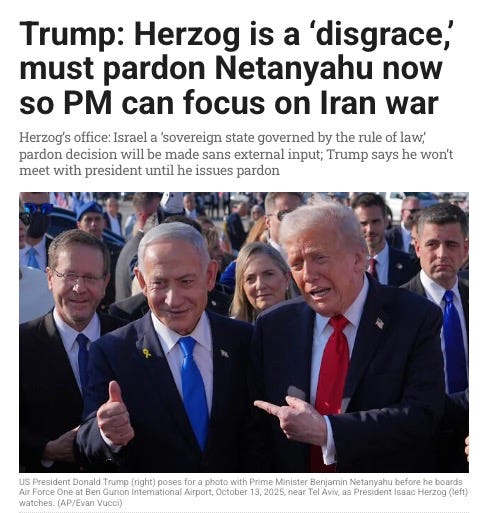
There was too much going on with the war for the shock at Donald Trump’s utterly outrageous demand that President Isaac Herzog pardon PM Netanyahu “today” to get the attention that it deserved. Donald Trump calling Isaac Herzog “a disgrace” was beyond disgusting. It was vintage Trump; obviously, he likely raised the issue because Netanyahu asked him to, directly or indirectly, but still, it was appalling.
Back in history to an earlier “Herzog Pardon”
Trump aside, the issue of Bibi’s pardon is bound to return to the headlines when the winds of war subside.
To give our readers a bit of context, we’re turning our attention today to different pardon by “a Herzog,” many years ago.
On a spring night in April 1984, Egged Bus 300 left Tel Aviv for Ashkelon carrying forty-one passengers—soldiers heading home and civilians ending an ordinary day. Somewhere along the coastal road, four Palestinian terrorists armed with knives and a suitcase said to contain a bomb took control of the bus. They demanded the release of 500 Palestinian prisoners and ordered the driver south, toward the Egyptian border.
It was, tragically, a familiar script, and Israel had learned to deal with it. Near the Deir el-Balah refugee camp in Gaza, about ten miles north of the Egyptian border, IDF fire disabled the vehicle. At dawn, Sayeret Matkal—the country’s elite commando unit—stormed the bus. The rescue was swift and largely successful, but not without cost: nineteen-year-old soldier Irit Portuguez was killed, apparently by IDF fire.
Within hours, the military announced that all four terrorists had been killed during the rescue. Most Israelis accepted that without much question.
But soon afterward, a photograph by veteran photographer Alex Levac appeared in the press. It showed one of the hijackers—Majdi Abu Jummaa—alive, handcuffed, being led away by Israeli forces. The image was unmistakable. Someone, somewhere, was lying.
Copyright limitations on this photograph are quite strict, and preclude our posting it here. If you’d like to see the photo, however, you an visit this auction site. [NOTE: the site can sometimes take a while to load, but the link is correct.]
What emerged over the following months—and years—was not merely a story of institutional panic. Avraham Shalom, then head of the Shin Bet, had ordered that the two captured terrorists be killed. Later testimony revealed that they were taken to a nearby field and beaten to death with rocks and iron bars. No trial. No interrogation.
Worse still was what followed.

Author: Contributor
For more details on this author's background and expertise, please refer to the content within the article itself. The views and opinions expressed in this piece are those of the author and do not necessarily reflect the official policy or position of geula.news or its affiliates.