
The following essay was written and sent to me by John Emil Thomas Bernard, Ph.D., retired Professor of Mathematics. It was inspired both by my latest book, The Two Swords of Christ, as well as a recent livestream where I closely examined “Doormat Christianity”—the popular idea that Christianity begins and ends with its adherents behaving as passive, non-resistant doormats—in light of what Scripture actually says.
*****
Christianity begins with a startling claim about the human person: every man and woman is an immortal soul whose earthly life is only the first, brief chapter of an eternal story. The Christian tradition has always insisted that this temporal portion — fragile, unpredictable, and often marked by suffering — is nevertheless the decisive arena in which the soul’s eternal destiny is shaped. The saints of old lived with this truth burning in their bones. They knew that life on earth is short, but the consequences of how one lives are everlasting.
This conviction produced a distinctive moral clarity. If the soul lives forever, then earthly life, though precious, is not ultimate. It is a gift entrusted to us for the sake of virtue, sacrifice, and the building up of God’s kingdom. The early Christians, medieval Christians, and the great teachers of the Church understood that the call to holiness is not an invitation to passivity but to heroic virtue. The Christian is not merely to await heaven; he is to labor for the reign of God “on earth as it is in heaven.” The earthly portion of life is the only time in which courage, justice, and sacrificial love can be exercised. After death, the opportunity is gone.
This is the backdrop against which Raymond Ibrahim’s argument must be understood. Ibrahim contends that modern Christianity has lost the robust moral imagination of its ancestors. Premodern Christians lived in a world where death was common and evil was often violent. They did not romanticize suffering, but neither did they shrink from the hard truth that defending the innocent sometimes required force. Augustine’s just war principles, the witness of the Templars and Hospitallers, and the long centuries of Christian resistance to aggression all testify to a Church that believed both in the sanctity of life and in the moral duty to protect it.
Ibrahim’s historical claim is simple: without Christians willing to wield the secular sword, Christianity itself would not have survived. The record of history bears him out. Vast regions of the early Christian world were conquered by hostile powers. Had Christians refused to defend themselves, the faith would have been extinguished. This is not a celebration of violence but a sober recognition that evil often manifests in physical form and must sometimes be resisted in kind.
Yet Ibrahim is equally clear that Christianity has always affirmed a second sword — the spiritual sword. Prayer, repentance, sacramental life, evangelization, and the pursuit of holiness remain the heart of Christian existence. The spiritual sword is the primary means by which the Christian confronts sin, falsehood, and demonic powers. It is the sword Christ Himself wielded most often.
The tragedy of modern Christianity, Ibrahim argues, is that it has not merely emphasized the spiritual sword but has often done so at the expense of the secular one. A distorted reading of “turn the other cheek” has produced what he calls “doormat Christianity” — a version of the faith that equates goodness with harmlessness and holiness with passivity. This distortion is not only historically inaccurate; it is spiritually dangerous. A man who refuses to defend the innocent is not virtuous but negligent. A community that refuses to confront evil becomes complicit in its spread.
The Gospels themselves resist such distortions. Jesus drove the money changers from the temple with a whip. He challenged the man who struck Him. He praised a Roman centurion without demanding that he abandon his military vocation. John the Baptist told soldiers not to leave the army but to act justly within it. And Christ’s enigmatic instruction to His disciples — “sell your cloak and buy a sword” — was understood by earlier Christians as a symbolic affirmation of the twofold Christian vocation: spiritual warfare and temporal responsibility.
The Christian tradition, therefore, calls for balance. The spiritual sword must never be neglected, for without it the secular sword becomes mere violence. But the secular sword must not be abandoned, for without it the spiritual sword is left defenseless in a world where evil often takes physical form. The two swords are not rivals but partners. They serve the same Lord and advance the same kingdom.
This balanced vision has profound implications for the Christian understanding of martyrdom, sacrifice, and moral courage. To die in battle defending the innocent is not a failure of Christian love but an expression of it. Such a death, offered in justice and charity, participates in the mystery of Christ’s own self-giving. Romans 8:28 assures believers that God gathers even such deaths into His saving plan. The Christian who lays down his life for the protection of others imitates the Good Shepherd, who lays down His life for His sheep.
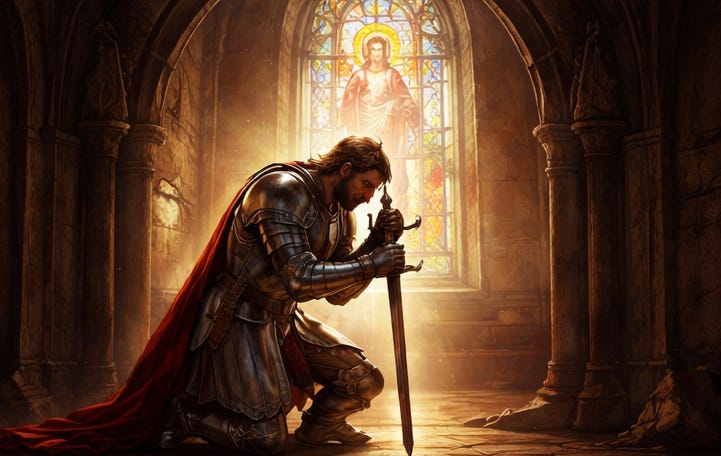
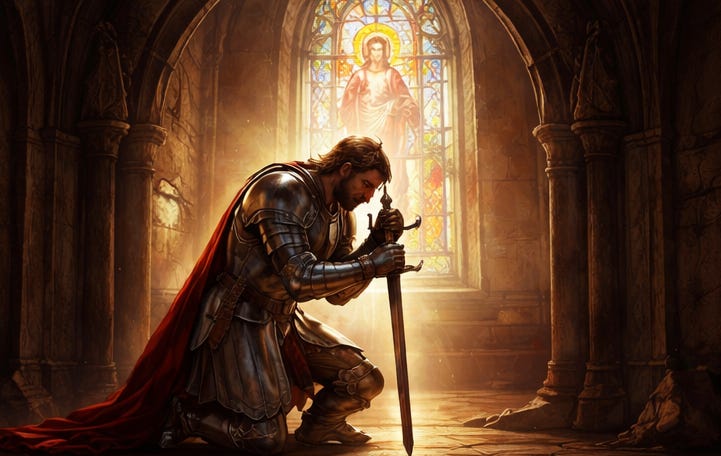
In an age marked by confusion, passivity, and moral disarmament, the Church must recover this integrated vision. We need saints who pray like monks and fight like knights. We need Christians who wield the spiritual sword with purity and the secular sword with justice. We need men and women who understand that their souls are eternal and that the brief earthly portion of their existence is the only time in which they can exercise the heroic virtue that echoes into eternity.
The world hungers for such Christians. The Church depends on them. And God honors them.
If you’d like to support my work and go deeper than what’s available publicly, consider a paid subscription. For just a few dollars a month, you’ll receive:
-
New, full-length articles every Week
Carefully researched pieces you won’t find elsewhere. -
Full access to the complete premium archive
Archive of in-depth writing, research, and commentary — all in one place.. -
Entry into the subscriber chat
A private space for serious readers and thoughtful discussion.

Author: Contributor
For more details on this author's background and expertise, please refer to the content within the article itself. The views and opinions expressed in this piece are those of the author and do not necessarily reflect the official policy or position of geula.news or its affiliates.