
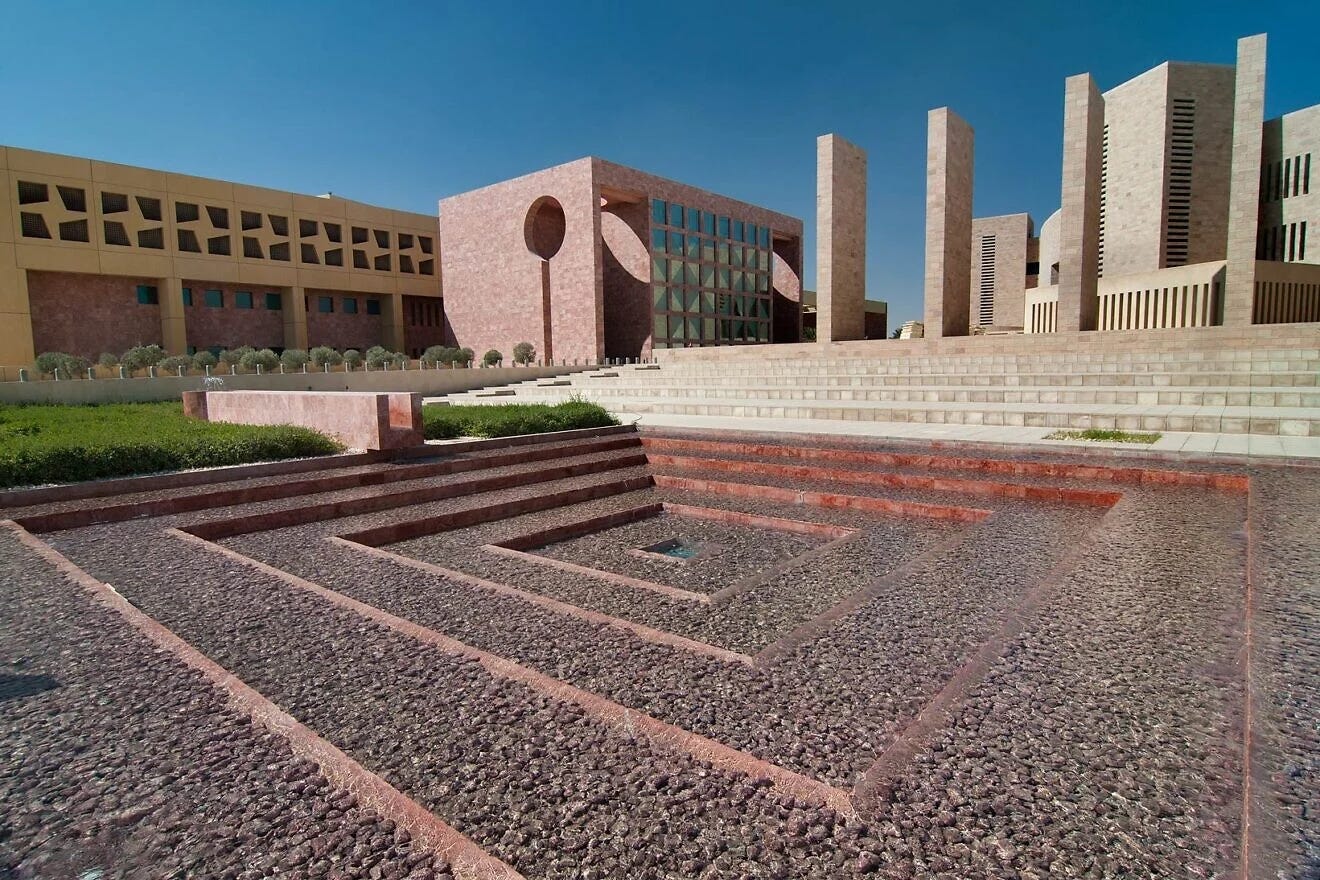
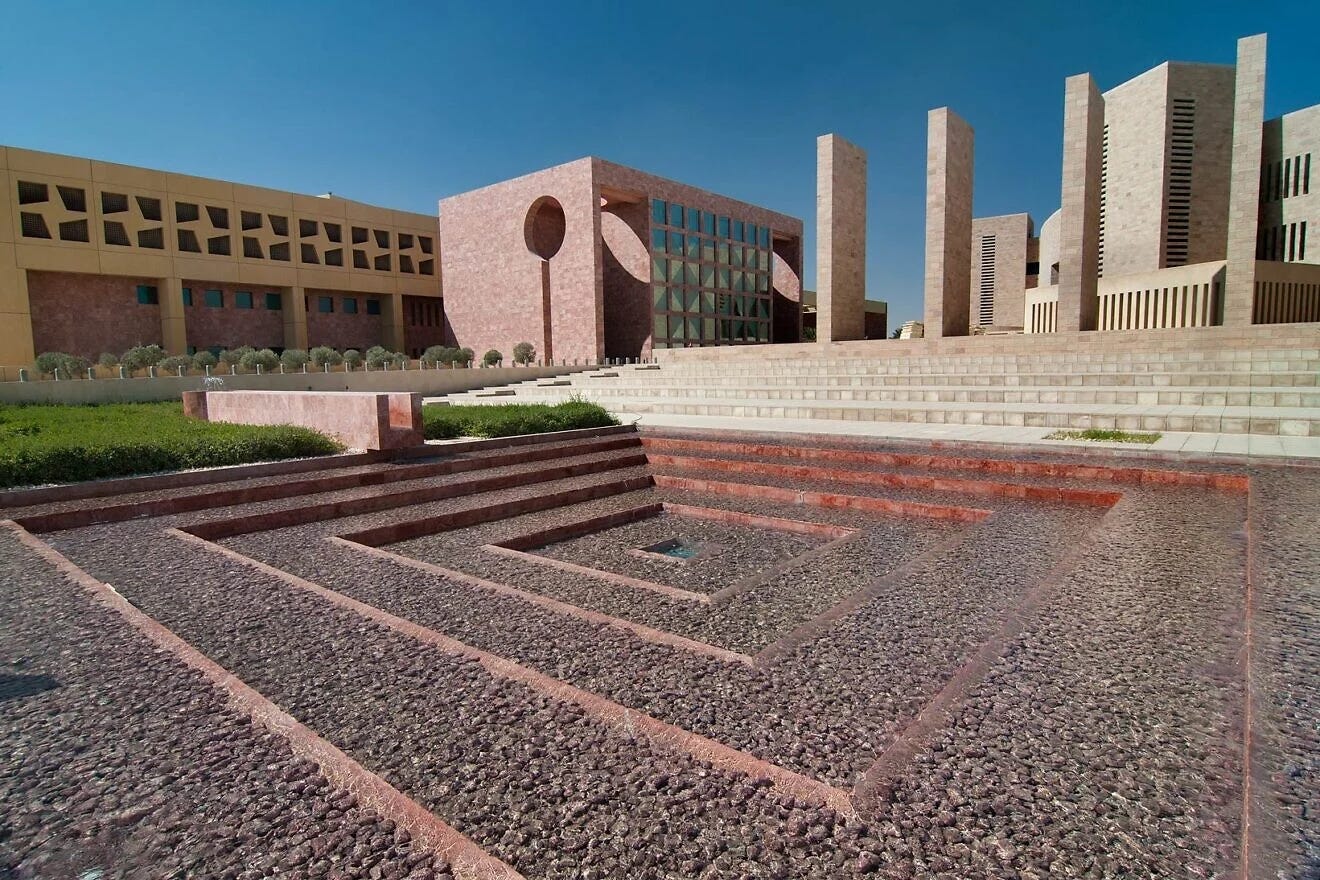
The fountain in the backyard area of Carnegie Mellon Qatar, March 4, 2012. Credit: Alex Sergeev (www.asergeev.com) via Wikimedia Commons.
by Mitchell Bard
(JNS) — Washington talks endlessly about foreign influence in American institutions. Yet when it comes to billions of dollars flowing from the Middle East into universities and colleges in the United States, the federal government still cannot—or will not—tell the public how the money is being used.
The Trump administration promised tougher enforcement of foreign-funding disclosure laws and greater transparency after years in which the Biden administration allowed reporting requirements to languish while antisemitism surged on campus. Enforcement has improved. Transparency has not.
According to the American-Israeli Cooperative Enterprise’s updated analysis of the U.S. Department of Education’s latest foreign-gift report, covering 1986 through Dec. 16, 2025, 14,427 donations totaling $16.2 billion from 14 Arab countries and the Palestinian territories were made to 294 U.S. universities—about one-quarter of the $67.6 billion American schools received from all foreign sources.
The striking figure, however, isn’t the total. It’s the secrecy. Nearly three-quarters of Arab funding—about $12.1 billion—lists no stated purpose. Americans have no idea what it bought, funded or influenced.
Three governments dominate: Qatar ($7.7 billion), Saudi Arabia ($4.2 billion) and the United Arab Emirates ($1.8 billion), together accounting for 85% of all Arab donations. Qatar alone has contributed roughly $3 billion more to American universities than Germany, Britain or China (minus Hong Kong, which adds $2 billion to its total). Yet of Qatar’s 1,260 recorded contributions, only 144—a mere 11 percent—worth $1.7 billion, include any description. Nearly $6 billion from a regime that funds Al Jazeera, hosts Hamas leadership and bankrolls Islamist organizations globally remains unexplained in official U.S. records.
The largest single gift highlights the problem. A $936 million donation to Carnegie Mellon University appears without explanation in federal disclosures, though outside reporting shows it funded the school’s campus in Doha. Similar nine-figure gifts largely support American satellite campuses in Qatar, including Weill Cornell Medicine and Texas A&M’s now-shuttering Doha program. Carnegie Mellon and Georgetown together have accepted more than $3 billion in Arab funding, yet federal reporting fails to specify how a single dollar is used.
The Trump administration’s DoE added a reporting column intended to identify donations from individuals, which is a welcome step in theory. In practice, however, it produced another black hole: 509 contributions totaling $317 million are labeled as individual gifts without naming a single donor.
What can be gleaned from the data that does exist?
Nearly half of the reported donations support tuition and scholarships for foreign students studying in the United States. The second-largest identifiable contribution—$254 million—funds Kuwaiti students at the University of Missouri. More than 40 percent of funding with a designated purpose went to the Doha campuses of Cornell, Texas A&M and Northwestern, and billions more likely flow to Qatari campuses, including that Carnegie Mellon donation, which are listed but never described in the DoE report. More than a dozen American universities operate campuses in the Middle East, yet the department identified funding for only one other.
Based solely on the DoE data, the evidence that Arab money directly bankrolls campus radicalism is limited to a solitary case: a professorship in Palestinian Studies at Brown University. The donors are not identified; only contributions from the non-existent State of Palestine, and from England and the United Arab Emirates, are identified. The position was predictably given to a vehement critic of Israel who supports boycotting the Jewish state.
Nevertheless, some analysts have tried to connect Arab funding to the rise of antisemitism on campus. The evidence is tenuous. How plausible is it that hostility toward Jews and Israel increased in Ithaca, N.Y., because Cornell received money for a medical center in Doha? A 2023 lawsuit by a Carnegie Mellon student alleged that Qatari funding influenced how the university managed antisemitism complaints, and a judge agreed that the university’s heavy reliance on foreign donors could reasonably create perceived pressure to accommodate donor expectations. But beyond the five universities with Doha campuses, the case for direct influence across the 62 other institutions receiving Qatari support remains unestablished.
Some of the campuses with the worst antisemitism problems—among them, the University of California, Los Angeles and the University of California, Berkeley—are not major recipients of Arab funds. And no evidence ties Arab money to the academic departments that are the greatest source of animus toward Jews and Israel, such as gender studies, ethnic studies and anthropology. Intersectionality, the intellectual framework that seeks to associate Israel and Jews with all the world’s ills, is not a product of Gulf State largesse.
Beyond five American universities with Doha campuses, the case for direct influence across the 62 other institutions receiving support from Qatar—the largest giver of funds, followed by Saudi Arabia and the United Arab Emirates—remains unestablished.
Mitchell Bard is a foreign-policy analyst and an authority on U.S.-Israel relations. He has written and edited 22 books, including “The Arab Lobby,” “Death to the Infidels: Radical Islam’s War Against the Jews;” “After Anatevka: Tevye in Palestine;” and “Forgotten Victims: The Abandonment of Americans in Hitler’s Camps.”

Author: Contributor
For more details on this author's background and expertise, please refer to the content within the article itself. The views and opinions expressed in this piece are those of the author and do not necessarily reflect the official policy or position of geula.news or its affiliates.