

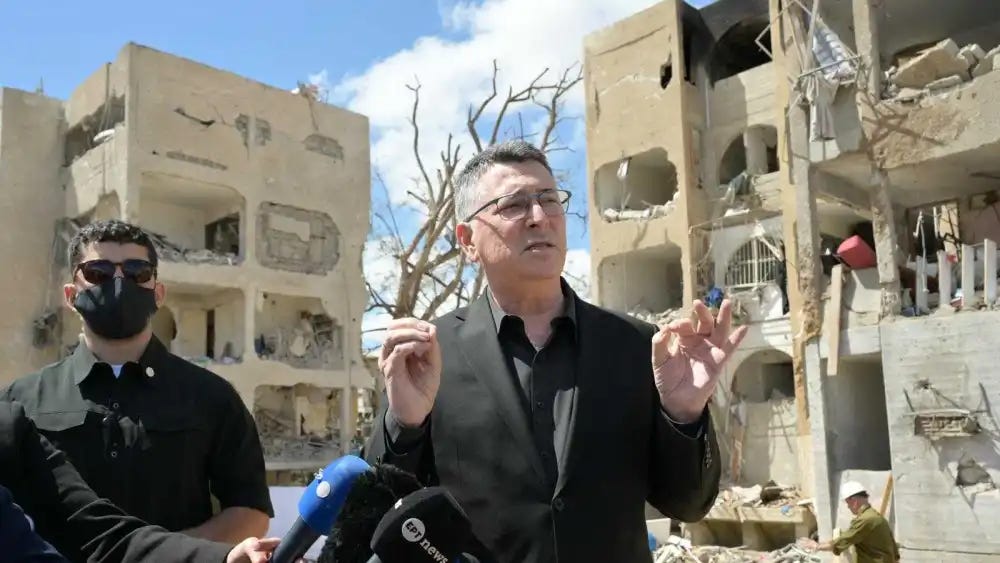
Israeli Foreign Minister Gideon Sa’ar speaks to reporters at the site of the Iranian missile strike in Arad, March 22, 2026. Photo by Shlomi Amsalem/GPO.
by David Litman
(CAMERA) — In the Information Age, politics, culture, and economies turn on the flow of information. So, too, does war. When malign actors seek to use the flow of information for their ends, it behooves democratic societies to respond intelligently. Instead, Western media is serving as an asset for the Islamic Republic of Iran’s propaganda.
Consider a 2022 article at the Articles of War blog of the Lieber Institute for Law & Warfare at West Point aptly titled “When Combat Becomes a Supporting Effort to Information.” In war, authors Professor Geoffrey S. Corn and Lt. Gen. (Ret.) Robert P. Ashley explain, legitimacy “turns on both the actual and perceived respect for law and morality” and can be a decisive factor toward the achievement of strategic goals. This is particularly so when our foes are “facing substantial tactical and operational disadvantage” and “increasingly understand that the more effectively they delegitimize their adversaries, the more likely they are to achieve strategic success.”
Exacerbating this is the unfortunate state of Western journalism. Unwittingly or otherwise, mainstream media outlets have become a key tool for our adversaries in the battle for legitimacy.
Consider how the phrase “war crime” has been used in reporting on the ongoing war with Iran. Using a simple Google search for the words “war crime” and “Iran” at five major outlets, one finds the term is almost exclusively used against the U.S. and Israel.
Analyzing the use of the term by the BBC, CNN, NBC, the New York Times, and the Washington Post, CAMERA found 32 total applications of the phrase “war crime” during the first three weeks of the war (Feb. 28 – Mar. 21). Of those, 28 (88 percent) were directed solely toward the actions of the United States and/or Israel. Zero were directed solely toward the actions of the Islamic Republic of Iran. Four (12 percent) were unattributed or directed at both sides.
The disproportionate application of the phrase stands in contrast with reality.
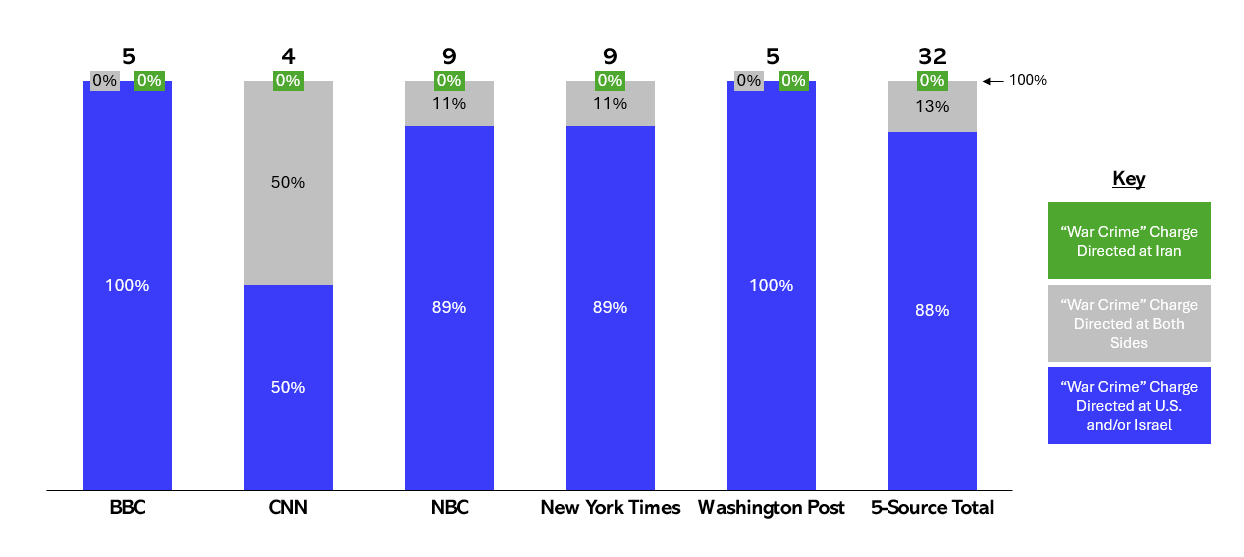
Of the allegations against U.S. and Israeli forces, almost all refer to a single strike at the beginning of the war which allegedly hit a school building that was originally part of an adjacent military base in Minab, Iran. While the U.S. military is still investigating the incident, preliminary reports indicate the strike was mistakenly carried out based on outdated intelligence. Several of the other allegations refer to the sinking of an Iranian warship in the Indian Ocean in what can assuredly be classified as a lawful attack.
Meanwhile, consider just some of Iran’s wartime acts that escaped the media’s “war crimes” focus. Of the over 400 ballistic missiles fired at Israel, it is estimated that half of them were cluster munitions which drop dozens of submunitions over a wide radius of five miles. As of Mar. 22, at least two dozen of these missiles have hit populated areas, “with over 100 separate impact sites.” While cluster munitions are not universally banned, using them to target populated areas almost certainly constitutes a war crime.
Iranian regime forces have also hit other civilian targets. Iranian drones and ballistic missiles have hit multiple hotels (including the Burj al-Arab and the Palm Jumeirah) and airports in the United Arab Emirates. The targeting of oil and gas facilities in Saudi Arabia (including the Ras Tanura and SAMREF refineries and the Shaybah Oil Field), Qatar (including at Ras Laffan and the Mesaieed Complex), Kuwait (including the Mina al-Ahmadi and Mina Abdullah refineries), and Bahrain (including the BAPCO refinery on Sitra Island and al-Ma’ameer Oil Facility) – countries which did not join the war – also raises questions, given that their status as lawful military targets is dubious. Iranian drones have hit an airport and near a school in Azerbaijan, another country not party to the conflict. Iranian forces have fired on at least 16 tanker, cargo, and commercial ships in the Persian Gulf.
Iran’s attacks have killed a few dozen civilians throughout Israel and the wider Middle East region. That the toll is not dramatically higher is thanks only to the incredible resources these nations have poured into protecting their civilian population, including Israel’s bomb shelters and state-of-the-art air defense systems.
Other Iranian acts raise more questions. There is growing evidence of the use of human shielding. On Mar. 8, U.S. Central Command issued a “safety warning” to Iranian civilians, warning that the “Iranian regime is using heavily populated civilian areas to conduct military operations,” including in the cities of “Dezful, Esfahan, and Shiraz.” As reported by the Foundation for Defense of Democracies, videos have emerged showing Iranian forces “in sports complexes, schools, and universities in cities across the country, including Bushehr, Tabriz, Yazd, Bandar Abbas, Gorgan, Qazvin, and Tehran.” One Iranian official even held a press conference in a classroom at the Shahid Mahalatti School in Tehran.
Yet, of the five outlets examined, not one used the phrase “war crime” regarding these Iranian acts. In the rare case where Iran was included in the discussion of war crimes, the authors inevitably balanced it with an equal charge against Israel and the United States.
This journalistic malpractice inverts reality. It creates a perception of illegitimacy against the U.S. and Israel by associating the word “war crimes” with their actions. This is so even as the examples given are limited and appear to be either tragic mistakes or legally illiterate allegations. Simultaneously, these outlets are creating a perception of legitimacy, by way of omission, for the Iranian regime even as it regularly lobs cluster munitions at densely populated cities.
The credibility of Western journalism isn’t the only victim here. Through their imbalanced coverage, these outlets are effectively aiding the Iranian regime toward accomplishing its strategic objectives by distorting reality. This does a dangerous disservice not only to American and Israeli servicemen and women, but to the millions across the Middle East that have been victimized by the Iranian regime and its proxy terrorist network.
This isn’t to say journalists shouldn’t do their job and report critically on U.S. and Israeli military operations. Both should be held to account. Rather, it is to say that so should Iran. Journalists need to start doing their job fully.
Originally published by the Committee for Accuracy in Middle East Reporting and Analysis.