

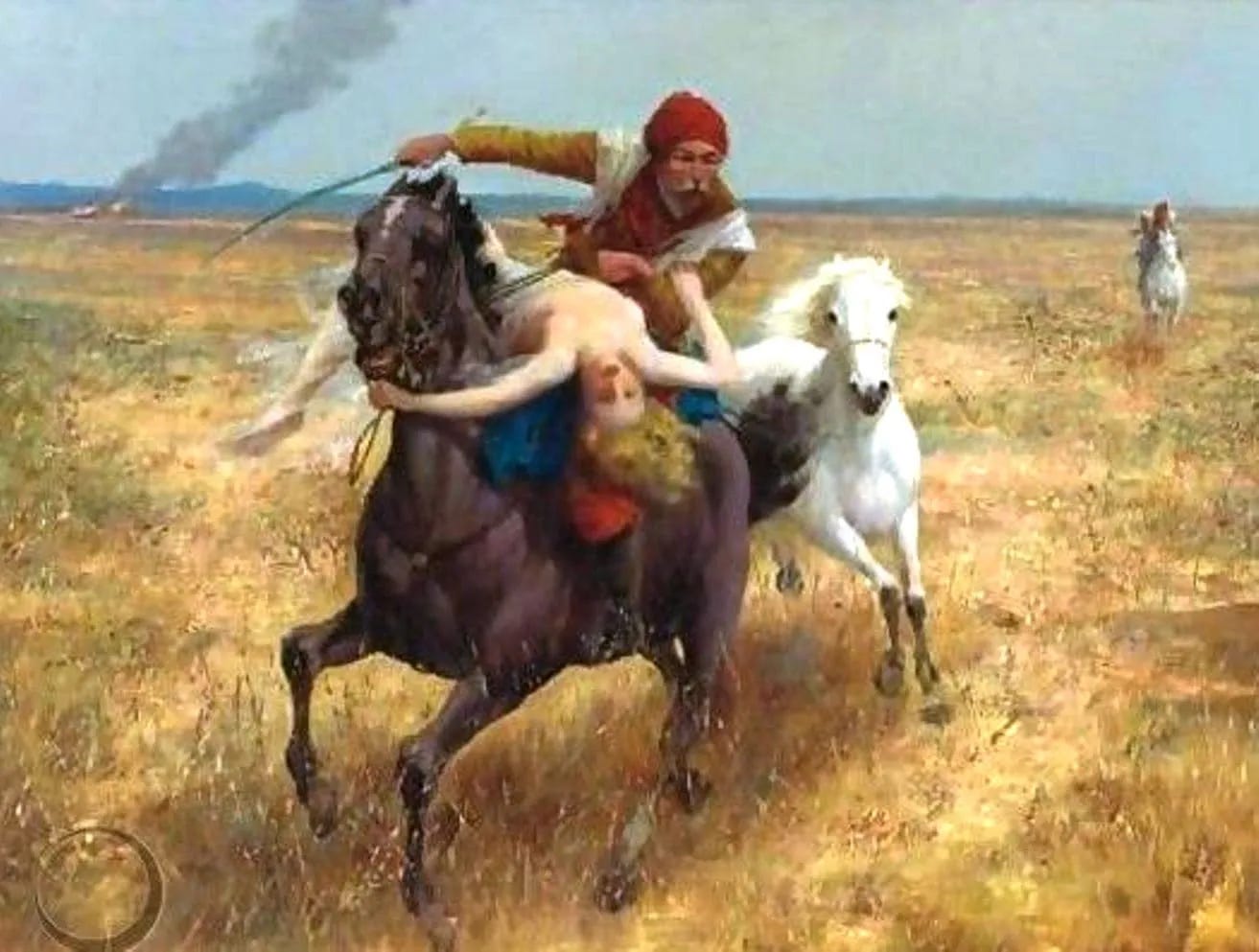
The ongoing revelations of Muslim “grooming gangs” targeting young white girls for sexual exploitation in the UK is as old as Islam itself — tracing back to Muhammad himself.
Much literary evidence attests to this in the context of Islam’s earliest predations on Europeans. According to Ahmad M. H. Shboul (author of Byzantium and the Arabs: The Image of the Byzantines as Mirrored in Arabic Literature) the Eastern Roman Empire (“Byzantium”) was the “classic example of the house of war,” or Dar al-Harb — that is, the quintessential realm that needs to be conquered by jihad. Moreover, it was seen “as a symbol of military and political power and as a society of great abundance.”
The similarities between pre-modern Islamic views of Eastern Rome and modern Islamic views of the West — powerful, affluent, desirable, but also the greatest of all infidels — should be evident. But they do not end here. To the medieval Muslim mindset, Byzantium was further representative of “white people” — fair- haired/-eyed Christians, or, as they were known in Arabic, Banu al-Asfar, “children of yellow” (reference to blonde hair).
Continues Shboul:
The Byzantines as a people were considered as fine examples of physical beauty, and youthful slaves and slave-girls of Byzantine origin were highly valued…. The Arab’s appreciation of the Byzantine female has a long history indeed. For the Islamic period, the earliest literary evidence we have is a hadith (saying of the Prophet). Muhammad is said to have addressed a newly converted [to Islam] Arab: “Would you like the girls of Banu al-Asfar?” Not only were Byzantine slave girls sought after for caliphal and other palaces (where some became mothers of future caliphs), but they also became the epitome of physical beauty, home economy, and refined accomplishments. The typical Byzantine maiden who captures the imagination of litterateurs and poets, had blond hair, blue or green eyes, a pure and healthy visage, lovely breasts, a delicate waist, and a body that is like camphor or a flood of dazzling light.1
While the essence of the above excerpt is true, the reader should not be duped by its overly “romantic” tone. Written for a Western publication by an academic of Muslim background, the essay is naturally euphemistic to the point of implying that being a sex slave was desirable — as if her Arab owners were enamored devotees who merely doted over and admired her beauty from afar.2
Indeed, Muhammad asked a new convert “Would you like the girls of Banu al-Asfar?” as a way to entice him to join the jihad and reap its rewards — which, in this case, included the possibility of enslaving and raping fair women — not as some idealistic discussion on beauty.
A quick reminder:
If you’d like to support my work and go deeper than what’s available publicly, consider a paid subscription. For just a few dollars a month, you’ll receive:
-
New, full-length articles every Week
Carefully researched pieces you won’t find elsewhere. -
Full access to the complete premium archive
Archive of in-depth writing, research, and commentary — all in one place.. -
Entry into the subscriber chat
A private space for serious readers and thoughtful discussion.